video start 33:30
MOTIVATE
If you’re new school, you pay attention to the weather app on your cell phone. If you’re old school, then you watch or listen to a news meteorologist discuss weather patterns and predictions. Today’s meteorologists examine Doppler Radar and satellite data to determine weather expectations. Interestingly, a 5-day forecast is typically 90% accurate, a 7-day forecast is 80% accurate, and a 10-day forecast is only about 50% accurate.[1]
When it comes to forecasting of the return of Jesus Christ, the predictions about when it will happen have been 100% incorrect. We know this because Christ’s church is still present. During the time of the Thessalonians, people were not only predicting Christ’s return but stating it had already happened. And some were worried they had missed Jesus.
The apostle Paul wanted to encourage Christians that Jesus’ return was certain but also instruct them about the circumstances of the end times. In this letter we discern two summary principles for Christ’s return.

EXAMINE 2 Thessalonians 2:1-17
1 Now concerning the coming of our Lord Jesus Christ and our being gathered together to him, we ask you, brothers, 2 not to be quickly shaken in mind or alarmed, either by a spirit or a spoken word, or a letter seeming to be from us, to the effect that the day of the Lord has come.
3 Let no one deceive you in any way. For that day will not come, unless the rebellion comes first, and the man of lawlessness is revealed, the son of destruction, 4 who opposes and exalts himself against every so-called god or object of worship, so that he takes his seat in the temple of God, proclaiming himself to be God. 5 Do you not remember that when I was still with you I told you these things? 6 And you know what is restraining him now so that he may be revealed in his time. 7 For the mystery of lawlessness is already at work. Only he who now restrains it will do so until he is out of the way. 8 And then the lawless one will be revealed, whom the Lord Jesus will kill with the breath of his mouth and bring to nothing by the appearance of his coming. 9 The coming of the lawless one is by the activity of Satan with all power and false signs and wonders,
10 and with all wicked deception for those who are perishing, because they refused to love the truth and so be saved. 11 Therefore God sends them a strong delusion, so that they may believe what is false, 12 in order that all may be condemned who did not believe the truth but had pleasure in unrighteousness. 13 But we ought always to give thanks to God for you, brothers beloved by the Lord, because God chose you as the firstfruits to be saved, through sanctification by the Spirit and belief in the truth.
14 To this he called you through our gospel, so that you may obtain the glory of our Lord Jesus Christ. 15 So then, brothers, stand firm and hold to the traditions that you were taught by us, either by our spoken word or by our letter. 16 Now may our Lord Jesus Christ himself, and God our Father, who loved us and gave us eternal comfort and good hope through grace,
17 comfort your hearts and establish them in every good work and word.
Christians are to be educated about Christ’s return.
1 Now concerning the coming of our Lord Jesus Christ and our being gathered together to him, we ask you, brothers, 2 not to be quickly shaken in mind or alarmed, either by a spirit or a spoken word, or a letter seeming to be from us, to the effect that the day of the Lord has come. 3 Let no one deceive you in any way.
Following the last chapter, Paul reminded the Thessalonian believers that their suffering was confirmation that Jesus is with them. He also sought to encourage them that God will relieve their affliction and avenge their persecution (1:6).
Now, Paul writes specifically about the coming (παρουσίας) of Jesus (2:1, 8). It is also same word Paul used in his earlier letter (1Th 3:13; 4:15; 5:23), and the same word James uses to reference Jesus’ return (Ja 5:7-8), Peter used (2Pet 1:16; 3:4, 12), John used (1Jn 2:28), and the same Jesus used (Matthew 24:3, 27, 37). Additionally, Paul’s wording in v.1 of believers being “gathered together” is the same word Jesus used in Mt 24:31 “The [Son of Man] will send out His angels with a loud trumpet call, and they will gather together His elect from the four winds.” Likewise, Paul’s emphasis of the believers being “alarmed” only shows up on the lips of Jesus referencing His return (Mt 24:6; Mk 13:7 “you will hear of wars and rumors of wars. See that you are not alarmed, for this must take place, but the end is not yet). So, Paul’s theology/eschatology is in line with Jesus and the pattern of the NT.
Paul’s primary concern for writing about the return of Jesus is because these believers were being deceived. This will be addressed in my next point, but I want to spend a few moments educating and explaining a doctrine that is minimally understood among Christians.
Eschatology (end time study) is either bloated or boxed among most Christians. If it’s bloated, then exaggerated focus with precise details and calendars of sensationalized events are described in full detail. If it’s boxed, then the topic is left unstudied, believing we cannot know much about it. But Paul does not want our eschatology to be bloated or boxed, he wants us to be informed and prepared. Despite only having spent 3-weeks preaching the gospel with the Thessalonians (Ac 17:2), and a few short months later writing a letter, Paul educated these new believers about this subject. See 2Thess 2:5 Do you not remember that when I was still with you I told you these things? And 1 Thessalonians 4:13“But we do not want you to be uninformed, brothers, about those who are asleep, that you may not grieve as others do who have no hope.” Therefore, our view should not be, “we can’t know” or “it doesn’t matter.”
Additionally, Christians should find it significant that Paul elucidates details about the end times while trying to encourage them about their struggles and suffering. Christians need the comfort of Christ’s return and hope of heaven to sustain themselves from the weight of this world.
Christians should find it significant that Paul elucidates details about the end times while trying to encourage them about their struggles and suffering. Christians need the comfort of Christ’s return and hope of heaven to sustain themselves from the weight of this world.
Tweet
So, before I begin, let me say there are differing views on this subject, even among sincere and smart Bible-believing Christians.
Some Christians believe in two separate παρουσίας, with the first as a rapture of believers and followed by a 7-year tribulation, thus known as Pre-tribulation rapture (PrT). The second παρουσίας is after the tribulation where Jesus comes to judge the earth and begin a millennium (1k years) reign.
SIDE NOTE: We should consider that from apostolic times and through church history through the 19th C, there has been no person or movement to clearly advocate the doctrine of a PrT rapture. For 1800 years, the Church had never considered distinguishing two stages of Jesus’ Second Coming as a legitimate doctrine until the 1860’s with John Darby, and then popularized by the Scofield Reference Bible in 1903.
Yet, in this view, they believe Paul is calming the Thessalonian worries that Jesus has already returned by saying that there were still major events to happen: 1) the rebellion (lit. “apostasy”) with the man of lawlessness, 2) the restraining of an individual. Thus, since these events had not taken place, they had not missed the rapture.
Jesus taught similarly in Mt 24:4-14 4 “See that no one leads you astray. 5 For many will come in my name, saying, ‘I am the Christ,’ and they will lead many astray. 6 And you will hear of wars and rumors of wars. See that you are not alarmed, for this must take place, but the end is not yet. 7 For nation will rise against nation, and kingdom against kingdom, and there will be famines and earthquakes in various places. 8All these are but the beginning of the birth pains. 9 “Then they will deliver you up to tribulation and put you to death, and you will be hated by all nations for my name’s sake. 10 And then many will fall away and betray one another and hate one another. 11 And many false prophets will arise and lead many astray. 12 And because lawlessness will be increased, the love of many will grow cold.
13 But the one who endures to the end will be saved. 14 And this gospel of the kingdom will be proclaimed throughout the whole world as a testimony to all nations, and then the end will come.
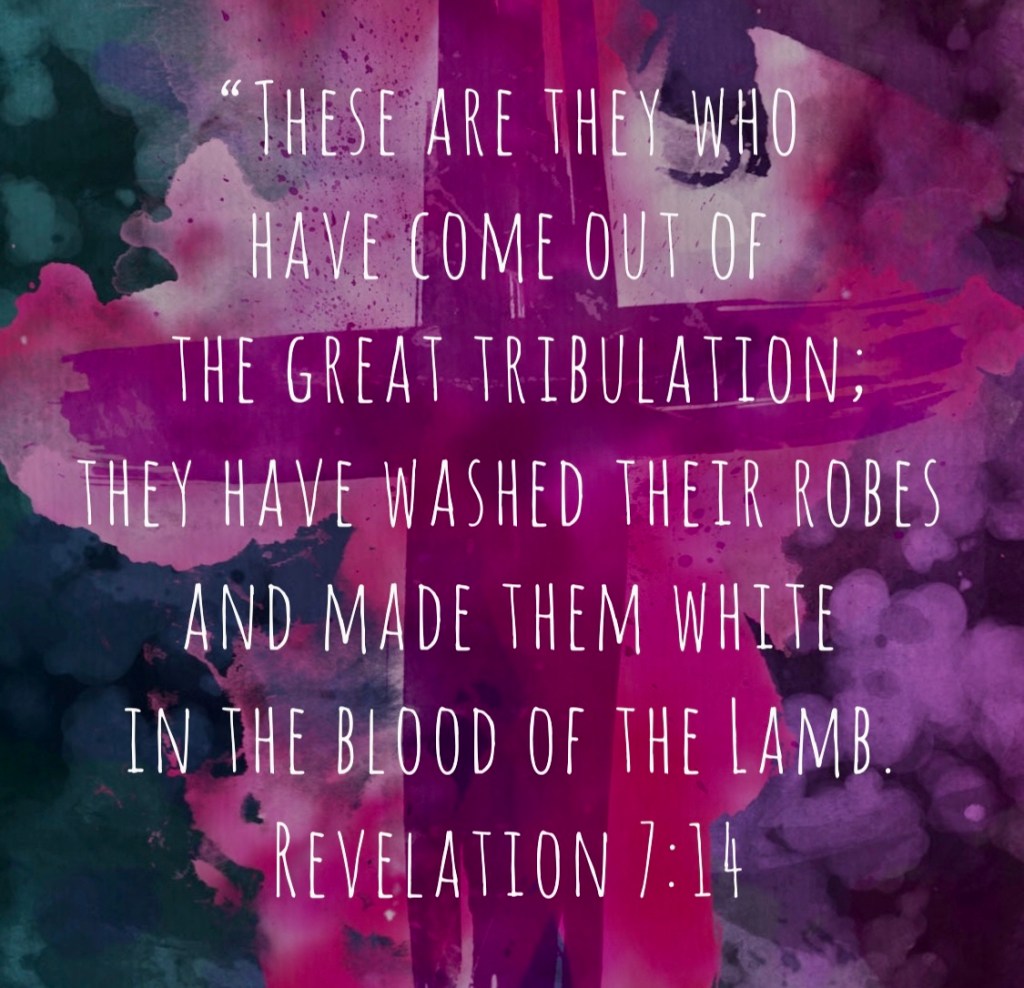
What we see before the second coming is a climactic and chaotic rebellion against Jesus Christ. The Gospel writers and the book of Revelation describe Jesus’ return following a time of Great Tribulation on earth that will include tragedy of great lengths. The word “tribulation” (thilipsis) occurs forty-five times in the New Testament, five times it contains the definite article (Matt 24:21, 29; Mk 13:19, 24; Rev 7:14). The overwhelming majority of the time the word is used is in reference to believers facing suffering. Therefore, the Great Tribulation is not God’s war on unbelievers but is more likely a war between the church and the anti-Christ, where the church prevails (cf Daniel 12:1-2; Rev 7:14).
*Specifically, PrT advocates use for their view Revelation 3:10 “Because you have kept my word about patient endurance, I will keep you from the hour of trial that is coming on the whole world, to try those who dwell on the earth.” This was one of the specific promises given to the Philadelphian church, which was the ability to persevere amid trials. Jesus promises protection in trial but this does not necessarily mean removal from trials. The verb is used similarly elsewhere:
- John 17:15 “I do not ask that you take them out of the world, but that you keep them from the evil one.”
- 2 Peter 2:9 “the Lord knows how to rescue the godly from trials, and to keep the unrighteous under punishment until the day of judgment”
- Revelation 3:10-12 context references a patient endurance, holding fast, and overcoming – all indicators of the Philadelphia Church experiencing a level of trial that is coming on the whole world, yet by the grace of God will be protected.
So, whether the Church will escape or endure a time of Tribulation may be up for debate. However, it does seem early Christianity expected tribulation and suffering would precede an end time return of Christ (Mat 24:15-31; Mk 13:7-20; Rev 7:14).
Further, God’s typical pattern for His people is to endure trials rather than escape them.
- Adam & Eve tested in garden, and after their fall were clothed with a sacrifice and given a promise about a seed of redemption.
- Noah and family rescued through a great flood.
- Israel sees and is spared the 10 plagues upon the Egyptians.
- Hebrew Men saved in the fiery furnace.
- Daniel saved in the lion’s den after a night’s stay.
In the last days before Jesus returns, the world will tremble, chaos will spread, riots and violence will erupt, and the systems and leaders we have placed way too much trust and hope will demonstratively disappoint and fail us. In those confusing, frenzied, and anarchic times, a man of supposed peace will promise deliverance for all who follow him, but it will be to their eternal regret. Yet, God’s promise for all who endure trials and tribulation, Jesus says we have nothing to fear and we can live courageously assured of victory.
Back to the Thessalonians – if Christians felt like they had missed the rapture and were in the day of the Lord (after the tribulation), wouldn’t Paul have asked, “Why have you forgotten that I told you believers will be raptured before the day of the Lord?” Why would Paul tell them about two sign events to look for if they weren’t going to be around when the events would happen after a supposed rapture?[2] Further, Paul’s wording is unchanged from v.1 to v.8 about Jesus’ coming, therefore the PrT position to insert a rapture is without merit based on context. And Paul describes exactly what Christian believers should be alert so they are not deceived.
2 Thess 2:3 3 For that day
What day? The παρουσίας day of the Lord. Paul is not separating events for the return of Jesus.
Paul says, this day will not come, unless the rebellion [apostasy] comes first, and the man of lawlessness is revealed, the son of destruction, 4 who opposes and exalts himself against every so-called god or object of worship, so that he takes his seat in the temple of God, proclaiming himself to be God.
So, before the return of Jesus, the man of lawlessness is revealed. Paul does not inform us of his name but does instruct his nature. And today, we would do well to be attentive, so we are not deceived but remain devoted to the Lord. The nature of the man of lawlessness…
- Is human/man. So, not a spiritual demon but a real person whom people, and eventually the world, will know as he is revealed.
- Is self-described above the law; subject to a different moral code and unaccountable to any lawgiver, as one who is “lawless.”
- Is a “son of destruction.” (2Th 2:3). In God’s sovereignty, this person was born and destined for this purpose.
- Is assumes the object of reverence and loyalty (2Th 2:4). This person is the culmination of all anti-Christ’s (cf 1Jn 2:18, 22; 4:3).
- Is unprecedented in power and unchallenged in deceptive influence w/ signs & wonders, which come from Satan (2Th 2:9-10; cf Dt 13:1-3).
- Is restrained until God determines, but eventually will be reduced to a puff of air, with the Lord Jesus killing him with the breath of His mouth and bring to nothing by the appearance of His coming (2Th 2:8).
SIDE NOTE: One may observe the PrT position contends the restrainer as the Holy Spirit present through the church. And once removed, the lawless one is unleashed for “all hell to break loose.”
While the restraining presence may be the Holy Spirit, one does not need to adopt PrT position. Further, contextually, the one Paul is referencing in vv.6-7 are one and the same in parallel form.[3]
6a “And you know what is restraining him now (God’s power)
6b so that he (antichrist) may be revealed in his time
7a For the mystery of lawlessness is already at work; only He who restrains (God) will do so
7b until he (antichrist) is out of the way.”
Application for education on Christ’s return
- Study it. Since this doctrine is taught by the Lord Jesus and promised as hope throughout the NT, then it is worthy of our attention. And read differing views so your bias is at least challenged.[4]
- Show humility. Knowledge of Christ’s return should not make us haughty but humble before a holy God. And fellow believers who hold differing eschatology are still Christian family.
- Knowledge puffs up but love builds up. Seek to build God’s kingdom by sharing the gospel #WhosYour1
Christians are to be equipped for Christ’s return.
10 and with all wicked deception for those who are perishing, because they refused to love the truth and so be saved. 11 Therefore God sends them a strong delusion, so that they may believe what is false, 12 in order that all may be condemned who did not believe the truth but had pleasure in unrighteousness. 13 But we ought always to give thanks to God for you, brothers beloved by the Lord, because God chose you as the firstfruits to be saved, through sanctification by the Spirit and belief in the truth. 14 To this he called you through our gospel, so that you may obtain the glory of our Lord Jesus Christ. 15 So then, brothers, stand firm and hold to the traditions that you were taught by us, either by our spoken word or by our letter.
16 Now may our Lord Jesus Christ himself, and God our Father, who loved us and gave us eternal comfort and good hope through grace,
17 comfort your hearts and establish them in every good work and word.
Paul’s primary concern for writing about the return of Jesus is because these believers were being deceived. Their faith hopes were dwindling and their life habits were deteriorating. Paul calls it an unrighteous/wicked deception, and they were refusing to love the truth (v.10). They were becoming idle and not working, thus making the church responsible to care for their needs.
The root of their deception, and the disposition of many today, is not a failure to understand the timing of the second coming but the failure of faithfulness. We are “prone to wander, prone to leave the God we love.” We do not cherish truthfulness to the Lord and we conceal our sin.
Christians and churches are weak because we love sin and selfishness more than we love our Savior. The right and good we want to do, somehow fails to come out (Rom 7).
The root of Thessalonian deception, and the disposition of many today, is not a failure to understand the timing of the second coming but the failure of faithfulness. We are “prone to wander, prone to leave the God we love.”
Tweet
So, Paul exhorts them to not to be shaken, alarmed or deceived at the signs of evil or the lawless one. Paul sees it vital to encourage believers to stand firm and hold to the faith traditions they were taught (2Ths 2:15).
- Gratitude for God is the antidote to end-time deception. If we are to protect ourselves for battle against apostasy and be equipped and prepared for the return of Jesus Christ, then we will need to commit to entering the sanctification process. Paul says, “we ought always to give thanks to God, because God chose you as the firstfruits to be saved through sanctification by the Spirit and belief in the truth (v.13). To this we are called through the gospel, so that we may obtain the glory of our Lord Jesus Christ (v.14). So, whether at each meal and several moments throughout the day, pause to thank God for salvation and surrender to His truth in your life.
- Continue in Christian community. If the Thessalonian believers neglected Paul’s letter or fellowship with believers, they would not have endured to salvation.
Gratitude for God is the antidote to end-time deception.
Tweet
APPLY/THINK
In all, the overwhelming witness is that Jesus promises to return.
- Jesus said, “In my Father’s house are many rooms. If it were not so, would I have told you that I go to prepare a place for you? And if I go and prepare a place for you, I will come again and will take you to myself, that where I am you may be also.” (Jn 14:2-3)
The bookends of Revelation say that Jesus is coming with the clouds and every eye will see Him (Rev 1:7; 22:7). And the end of the book is an invitation: “let the one who is thirsty come; let the one who desires to take the water of life without price” (Rev 22:17).
Come out of sadness from wherever you’ve been
Come broken-hearted let the rescue begin.
Come find your mercy, O sinner come kneel.
Earth has no sorrow that Heaven can’t heal.
Come as you are. Come as you are
And let the Savior, change your heart.
[1] https://scijinks.gov/forecast-reliability/
[2] See Douglas Moo, Three Views Of The Rapture, p.189.
[3] See George Ladd, The Blessed Hope, p.95.
[4] See Three Views On The Rapture by Craig Blaising, Alan Hultberg, And Douglas Moo. And Three Views On The Millennium and Beyond by Craig Blaising, Kenneth Gentry Jr., and Robert B. Stimple.
 Growing Godly Generations