MOTIVATE
Wicked is winning all around us.
- Increasingly, churches compromising the gospel. It disheartens Christians to see churches dilute truth or depart from Christian doctrine. Yet, these occurrences also help us to stand united with other churches who are gospel affirming – even ones that may have slight differences – to stand in some level of unity and not competition with them.
- Addiction is rampant. Both legal and illegal opioid usage is the unquestioned pandemic of our age.
- There are mass shootings close by, whether it is Baltimore close to leading the nation with senseless shootings or violent murders, or happenings in any other local or regional city, especially within schools or churches.
There are violent attacks in our home country, and of course around the world. Whether it’s genocides in Africa, dictators in Nicaragua, repression in Cuba, invasion of Ukraine, or terrorism toward Israel. Specifically, the recent attacks of Hamas upon Israel are horrific. The nation of Israel has been under attack since its founding 3500+ years ago: whether it was the Amalekites (Ex 17:8-16), their King Agag (1 Sam 15:1-3), or Haman the Agagite (Es 3:1; 8:3).
While Hamas is a modern Islamic terrorist organization, it also stems from a word that is used 60x in the OT.[1] The word means zeal, specifically for wrongdoing or malicious violence. The hamas spirit originated with the people of Noah’s day (Gen 6:11), and continued with the rift between Sarai & Hagar and their children with Ishmael despising and ridiculing his baby brother Isaac (Gen 16:4-6; 21:9). Further, the OT prophets rebuked Israel for its hamas spirit of abusing the week (Isa 1:17; Jer 7:6; 22:3; Ez 16:49; Ze 7:10). Unfortunately, while people and civilizations change, the hamas, demonic, and Anti-Christ spirit remains the same (1 Jn 4:3).
In all, the present attack upon Israel is the most significant since the Holocaust. It’s comparable to the attack on U.S. soil, whether Pearl Harbor or 9/11. And once again, our minds are weighed with anxious thoughts and hearts burdened with the challenges of a tense and turbulent time. It seems each week and month is a transition from one agonizing trial or heartbreaking tragedy to the next. And this makes us tired and demoralized… but as Christians, we do not grieve without hope.
Today’s message is about trusting God in tumultuous times, and understanding what Christians can do when the wicked are winning.
Psalm 37 is our text today as this week and next are stand alone messages before a new 5-week series on the names of God, then another to start Christmas 🙂
Psalms are one of my favorites.
- Psalms elevate us into the presence of God. The word Psalm in Hebrew is tehilla, which means “to praise or to glory; to make music”. When the Psalms were translated into Greek, the title Psalmos was given, which means “songs; or ψάλλω: means twanging or striking with the fingers on musical strings, making melody.” So, the Psalms are a book meant to be prayed & praised to the glory of God.
The Psalms became the early church’s hymnbook. After about 1500 years of the same songs, some reforming Christians broke from singing only the psalms to creating new hymns that spoke of their current day’s context. The new hymn writers often utilized tunes from culture and created similar rich harmonies with distinct meter and set them to new godly lyrics that were sung in the church. How dare they!?!. And the church continues singing a new song to the Lord (Psalm 96:1; Eph 5:19; Col 3:16). - Psalms relate to us various life perspectives. They are part of the Wisdom literature in the Bible, and they offer descriptions about hardships of life, faith amid suffering, hope in God’s promises. Overall, the Psalms instruct and inspire us about the goodness and faithfulness of God in all things. They cover the range of life experiences and emotions that we all face in a variety of circumstances: lamentation, celebration, confession, and heartfelt worship.
- Psalms educate people and nations for navigating turbulent times. Most every psalm was written by a national leader, whether Moses, Asaph, or the Sons of Korah, or kings like David and Solomon. Consider that national leaders were writing songs for citizens of their kingdom to learn, sing, and enjoy. The whole purpose of songs, and art in general, is to reinforce history, raise awareness of present priorities, and to strengthen the character and focus for the future. Likewise, the Psalms educate and encourage us with a vision for who we are and where we are going.

EXAMINE
Psalm 37 is an acrostic poem with consecutive letters of the Hebrew alphabet for each stanza, in a poetic structure communicating wisdom for God’s people on what it means to trust God when the wicked are winning. In this psalm we can see 2 implications for the people of God when the wicked are winning.
Trusting God implies our faith overcomes fear (Ps 37:1-8).
1 Fret not yourself because of evildoers; be not envious of wrongdoers! 2 For they will soon fade like the grass and wither like the green herb. 3 Trust in the LORD, and do good; dwell in the land and befriend faithfulness. 4 Delight yourself in the LORD, and he will give you the desires of your heart. 5 Commit your way to the LORD; trust in him, and he will act. 6 He will bring forth your righteousness as the light, and your justice as the noonday.
7 Be still before the LORD and wait patiently for him; fret not yourself over the one who prospers in his way, over the man who carries out evil devices! 8 Refrain from anger, and forsake wrath! Fret not yourself; it tends only to evil.
The Psalmist gives multiple commands for what it means to have faith and trust in God. The first is negative, while the remaining are positive.
The first command repeated three times: fret not (37:1, 7, 8). The Hebrew word for fret = khawraw (to glow warm or be hot, or burn with anger and fury). So, the Psalmist is implying for us not to be controlled by fearful emotions. People of faith must be reminded to breathe before we emotionally respond with words or actions that we would later regret, or worse that would dishonor God.
- Illus: Emotions / Do you like scary or even suspense movies? If you watch one of these movies the plot becomes where the characters enter intense circumstances that their life is often in danger. The music gets faster and frantic. The actions become fearful and panicky.
AND sometimes people who are watching the movie feel like they are in the scene themselves! They curl their legs up, tense their arms and fists, maybe cover their eyes, or give a loud shriek! The movie manipulates your mind so that your feelings overcome reality. This is what fear does to us in real life.
Fear distracts. Fear hinders us from our focus. Fear paralyzes us from moving forward. Fear and fretting worry that God doesn’t know what to do, or is unable to act, or will somehow get it wrong. All of these are false realities or traits to the character of God. Yet, repeatedly, the Bible commands us not to fear. While it is natural to be afraid, we need not think with terror or act with alarm, but instead inform our fears with our faith.
While it is natural to be afraid, we need not think with terror or act with alarm, but instead inform our fears with our faith.
Tweet
God protects the righteous
- Ps 37 has the covenant name of God 16x. This should remind us that God is faithful. He cares and loves His children.
- Ps 37:18 “The Lord knows the days of the blameless and their heritage will remain forever.
- Ps 37:28b, 33 “The Lord will not forsake His saints. They are preserved forever… The Lord will not abandon them.
- Ps 37:39-40 “The Lord saves; He is the stronghold in the time of trouble; He helps and delivers them from the wicked, and saves them, because they take refuge in Him.
God is all-powerful, in control, and will condemn evil.
- Ps 37:5 “The LORD will act…
- Ps 37:12-13 “The wicked plots against the righteous and gnashes teeth at him, but the LORD laughs at the wicked, for He sees that their day is coming.”
- Ps 37:9 “evildoers will be cut off”
- Ps 37:15 “The sword of the wicked will enter their own heart and their bows be broken.”
- Ps 37:20 “the wicked will perish; the enemies of the LORD are like the glory of the pastures; they vanish like smoke”
- Ps 37:28, 34, 36, 38 the wicked will be cut off & short-lived.
- 2 Thess 1:9 “The unrighteous will suffer punishment of eternal destruction, away from the presence of the Lord”
Fear influences our thoughts and fretting shapes actions. The way faith overcomes fear is by establishing confidence in the Lord. God is wise and will not get it wrong. Our confidence builds by consistently reading His word, especially narratives (OT/Acts) – which is how the names of God are revealed.[2]
- Jer 32:17 “God made the heavens & the earth by His great power & outstretched arm. Nothing is too hard for the Lord.”
- Daniel 2:20; 11:32 “To God [alone] belongs wisdom and might… The people who know their God shall stand firm and take action.”

Another command to exercise our faith is a string of actions of trusting in the Lord, doing good, dwelling in the land, and befriend (pasture/feed) faithfulness (Ps 37:3).
It is here that the psalmist teaches us the meaning of what it means to have faith. The series of exhortations provides us with the path and practicality of trusting the Lord. Trust implies confidence/hope (bawtach; cf. Proverbs 3:5-6).
- Illus: Trust / Imagine a lifeguard noticing a drowning man who is large (tall & stocky). The lifeguard dives in the water and swims out to the struggling swimmer, but stops three feet from him. He notices the drowning man is struggling to save himself; he’s wildly swinging his arms and legs and unwilling to receive help. The lifeguard notices the man’s condition and treads water at a short distance away. He is waiting for the man to drain his energy and stop the effort of trying to save himself. As long as the man insisted on his own strength, and relying on his own ability, his approach would hinder the lifeguard and his cry for help would contradict his desire to be saved… When the drowning man ceased leaning on his own understanding and using his own methods, the lifeguard was able to enter and take over. The lifeguard worked his way around the man’s back to reach over his shoulder and cupping the chin under his hand to enable breathing, and then sidestroked to safety.
- Trusting God means our confidence and hope is in Him and not ourselves. Our understanding will lead us to act in ways that are contrary to God’s ways and will. We must trust that God has a rescue plan and it often doesn’t involve our preferred methods. When God saves a person through His gospel, He must get the glory and not us.
- Trusting God also means we live and do good. In other words, we obey what we know God has specifically called us to do. Too often we concern ourselves with what others should be doing and how God should be working, when instead we should simply keep our eyes on Jesus and follow who He has called us to be and what He has called us to do.
- Trusting God means we dwell in the land with God’s faithfulness. The psalmist uses language expressing God is faithful and we need only to live content in what He provides. Instead of endless exploration for happiness, children of God are to dwell in God’s promises and provision. While we wait upon God’s fulfillment of promises, we worship in God’s provision. That means waiting upon the Lord is not passive, but instead we are actively doing good, dwelling with gratitude, and being productive by planting seed, farming and bearing fruit in the harvest land that represents God’s kingdom.
Before looking at further commands of trusting the Lord, allow me a brief excursus on the phrase:
dwell in the land, mentioned 6x in Ps 37.
- Psalm 37:3 Trust in the LORD, and do good; dwell in the land and befriend faithfulness.
- Psalm 37:9 For the evildoers shall be cut off, but those who wait for the LORD shall inherit the land.
- Psalm 37:11 But the meek shall inherit the land and delight themselves in abundant peace.
- Psalm 37:22 for those blessed by the LORD shall inherit the land, but those cursed by him shall be cut off.
- Psalm 37:29 The righteous shall inherit the land and dwell upon it forever.
- Psalm 37:34 Wait for the LORD and keep his way, and he will exalt you to inherit the land; you will look on when the wicked are cut off.
In brief, the Abrahamic covenant promise of land should be understood with at least three realities[3]:
- The land represents God’s original design of Eden and the fullness of creation for God’s kingdom (cf. Ex 19:5-6; Ps 24:1). The Promised land began with a localized geographical plot but theologically and eschatologically represented something greater (cf. Heb 11:10; Gal 4:26).
- The covenant had both unconditional and conditional elements. If Israel obeyed God’s voice and kept His commandments, then they would forever be God’s treasured possession among all peoples of the earth. Yet, they broke covenant with Yahweh. However, thankfully, Yahweh promised and fulfilled a new covenant that fulfills the old in ways that multiplied beyond a single person or nation, or place (cf Jer 31:31-34; Mt 21:43; Rom 9:6-8; Gal 3).
- Like the old covenant was meant for blessing an international community (Gen 17:4-6; 22:18; Ps 67; etc.), so too the new covenant was instituted for a multi-ethnic community that no one can number, that is neither Jew nor Gentile but a people from every nation, tribe, and language standing before the throne of Jesus, and living in eternal community (cf Mt 28:19-20; Gal 3:28; Eph 2:13-19; Rev 7:9-10).
Therefore, God’s promise to His children to dwell in the land are far greater than a single nation with a small strip of land in the Middle East. God’s people will inherit the whole earth. That is not to say that God doesn’t have a special plan for the Jewish nation, but that OT Israel ≠ Modern Israel. This confusion not only causes unhelpful government policies, but theological error with bifurcating continuity between the covenants, and thus having the potential to create two gospels with varying ways for salvation and those citizens existing in God’s kingdom. Instead, there is only one God, one gospel, one body in the Lord Jesus Christ.
Back to Ps 37 for trusting God… Another set of commands is to delight in the Lord, commit your way to Him and to be still, waiting patiently for Him (Ps 37:4-7).
Here the psalmist is casting a vision for a person to immerse themselves in knowing and following the Lord. Delighting in God is a daily discipline that will produce depth and dynamic to your faith. It’s viewing personal devotion in God’s word as joyful relationship rather than chore or inconvenience. Commit (galal = roll) carries the idea of moving with God – like the meeting of a large stone rolling together with the ground, or perhaps like food ingredients rolled together – so faith in God is integrated in every area and fabric of life. Further, the psalmist exhorts us to stillness and patient waiting on the Lord, believing that He will act – bring it to pass (judging evil and bringing forth righteousness).
More action commands are to refrain from anger and forsake wrath (Ps 37:8).
The psalmist is a realist. He understand that when the wicked are winning, we are tempted to grow irritated and infuriated. He beckons back to the opening command of “fret not.” The command to forsake wrath is a reminder to not take vengeance into our own hands
- Psalm 37:14-15 “The wicked draw the sword… their sword shall enter their own heart”
- Romans 12:19-21 “Beloved, never avenge yourselves, but leave it to the wrath of God, for it is written, ‘Vengeance is mine, I will repay’ says the Lord. To the contrary, ‘If your enemy is hungry, give him bread to eat, and if he is thirsty, give him water to drink, for you will heap burning coals on his head, and the Lord will reward you. Do not be overcome by evil, but overcome evil with good.’” (cf. Prov 25:21-22).
- James 1:20 “for the anger of man does not produce the righteousness of God.”
- MLKJr. “Darkness cannot drive out darkness: only light can do that. Hate cannot drive out hate: only love can do that.”
In affirming these verses, we should not think there isn’t a personal role for self-defense or a national role for just-war. The Psalms are filled with imprecatory language – prayers for justice and God’s judgment upon evil. Romans 13 affirms that God appoints governing authorities to promote good conduct and punish evil.
It is righteous to pray for Hamas soldiers to be radically changed for genuine repentance and bold life-changing faith in the Lord Jesus; as well as it is proper to pray the terrorists to have their rockets derailed, guns to glitch, swords to bend, strength to shrink, and their regime to swiftly terminate.
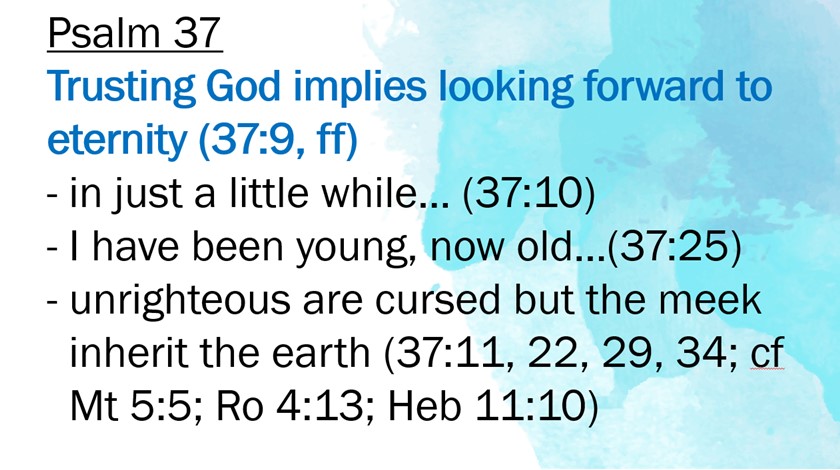
Trusting God implies looking forward to eternity and not just the present earth (Psalm 37:9-22).
9 For the evildoers shall be cut off, but those who wait for the LORD shall inherit the land. 10 In just a little while, the wicked will be no more; though you look carefully at his place, he will not be there. 11 But the meek shall inherit the land and delight themselves in abundant peace. 12 The wicked plots against the righteous and gnashes his teeth at him, 13 but the Lord laughs at the wicked, for he sees that his day is coming. 14 The wicked draw the sword and bend their bows to bring down the poor and needy, to slay those whose way is upright; 15 their sword shall enter their own heart, and their bows shall be broken. 16 Better is the little that the righteous has than the abundance of many wicked.
17 For the arms of the wicked shall be broken, but the LORD upholds the righteous. 18 The LORD knows the days of the blameless, and their heritage will remain forever;
19 they are not put to shame in evil times; in the days of famine they have abundance. 20 But the wicked will perish; the enemies of the LORD are like the glory of the pastures; they vanish—like smoke they vanish away. 21 The wicked borrows but does not pay back, but the righteous is generous and gives; 22 for those blessed by the LORD shall inherit the land, but those cursed by him shall be cut off.
The ultimate aim of Psalm 37 is to point God’s people beyond earth to eternity. God is the vindicator of the righteous and will avenge injustice and unrighteousness. “In just a little while” (Ps 37:10) is a reminder that life on earth is short compared to eternity. The psalmist notes Ps 37:25 “I have been young and now am old, yet I have not seen the righteous forsaken” This advanced age has achieved perspective for God’s present and future faithfulness. He points us forward reminding us several times that God’s people, the meek, shall inherit the land and live forever (Ps 37:11, 22, 29, 34; cf. Matthew 5:5; Romans 4:13; Hebrews 11:10).
God’s plan will never be thwarted. His reign is not on the ballot for re-election, as He will never be dethroned. God does not see the wicked as a threat. He does not view the demonic realm as an equal competitor. God’s victory is already won.
Ps 37:39 “The salvation of the righteous is from the Lord; He is their stronghold in the time of trouble.”
Col 2:15 “God disarmed the rulers and authorities and put them to open shame by triumphing over them through Christ.”
The Psalms teach us that we can weep for circumstances, lament at events, and soak our pillows with tears, but the steadfast salvation of the Lord is our anchor and hope. We can see the wicked prospering or the righteous declining, but we need to teach our eyes to look up because the Lord’s track-record is undefeated and imperishable.
“If we don’t see how the ‘kingdom come’ informs this life now, we become frantic about the things of this life, wanting to make them ultimate… The goal of history is not, after all, escape to heaven, but the merger of heaven and earth”
Russell Moore, Onward, p.52, 61
Colossians 3:2-4 “Set your minds on things that are above, not on things on earth. For you have died and your life is hidden with Christ in God. When Christ who is your life appears, then you also will appear with him in glory.”
Looking forward to eternity is not like waiting to grow old, or hit retirement, or until you die. Instead, looking for eternity is like the above passage to set our minds on things above – and the idea is daily, moment by moment. In other places the Bible commands us to “pray without ceasing.” How can we do this?
There are many ways to yearn for Heaven and motivated by eternity. A few practical suggestions:
- Read two psalms a day. After today, there are 70 days left until EOY. Imagine what reading all of Psalms will do for your faith perspective, prayer inspiration, and mental health.
- Share the gospel with increased urgency.
The Bible writes speak about the time being “the last hour” (1Jn 2:18). So, for two-thousand years we have been in the end times. The question remains, are we in the last minutes or moments of the last hour. The reality is we do not know, for no one knows the day or hour of the Lord’s return. Jesus taught that there will be great tribulation with wars and rumors of wars, and many will false prophets will arise, lawlessness will inflate, and the love of many will grow cold (Mt 24:6, ff). While we cannot control our circumstances or manufacture justice, we can introduce people to the Prince of Peace. In fact, Jesus taught the preaching of the gospel to all nations is the only way we can speed the end (Mt 24:14; 2 Pet 3:11-13).
APPLY/THINK
Where there is not worship, there is war.
Let us pray for global peace, but also personal peace so that souls that are struggling, in conflict, and at war within themselves might find the presence and comfort of the Lord who delivers from oppression and redeems what was meant for evil to be used for good.
[1] https://biblehub.com/hebrew/2555.htm
[2] Join an online reading plan starting November 1: https://bible.com/p/61732915/7b82ce7a554337155891ec0f2d8a36d1
[3] Summary ideas from Oren Martin, Bound For The Promised Land.
 Growing Godly Generations