Christmas Eve PM
MOTIVATE In 2023, holiday retail sales in the U.S.A. are forecasted to reach $957 billion. This amount has increased every year and doubled since the turn of the century. The winter holiday retail season includes Thanksgiving weekend, which is made up of Black Friday, Small Business Saturday, and Cyber Monday, along with Christmas itself.
Each year people wander from shop to shop or browse numerous websites hoping for inspiration to leap off a shelf to identify the perfect gift. Sometimes the gift is the one heavily promoted in front of the store or ad headlines. At other times, the best gift didn’t come from advertisements and banners but the carefully researched selection of the individual.
You see, choosing the perfect gift is about the person not the shopper. It’s not entirely helpful to think,
“What would I want?” Selecting which gift to purchase requires you to listen and pay attention throughout the year. In my childhood, we had the Sears catalogue that we could circle items or dog-ear pages. Today, an Amazon “wish list” helps too – whether you’re the one adding to it, / or… you cheat and have the person say, “Hey Bozo, buy me this!” (ps: Hi, I’m Bozo, what’s your name?)
But seriously, it’s a special feeling when you’re the giver of a gift that the recipient’s face beams with joy and you know you’ve hit the target… unless you’re the parent of a preschool child who sees every wrapped box and repeatedly shouts, “The present I’ve always wanted!” And the next sentence asks, “What is it?”
When it comes to the gifts that the Magi bought the Christ-child, many of us read this Scripture and are asking the same question: “What is this?”
This evening let’s look at Matthew 2:1-12 to ask and answer some questions about these magi, and how their gifts reveal ways we can celebrate Jesus too.

EXAMINE Christmas Gifts PM
1 Now after Jesus was born in Bethlehem of Judea in the days of Herod the king, behold, wise men from the east came to Jerusalem, 2 saying, “Where is he who has been born king of the Jews? For we saw his star when it rose and have come to worship him.” 3 When Herod the king heard this, he was troubled, and all Jerusalem with him; 4 and assembling all the chief priests and scribes of the people, he inquired of them where the Christ was to be born. 5 They told him, “In Bethlehem of Judea, for so it is written by the prophet: 6 “‘And you, O Bethlehem, in the land of Judah, are by no means least among the rulers of Judah; for from you shall come a ruler who will shepherd my people Israel.’” 7 Then Herod summoned the wise men secretly and ascertained from them what time the star had appeared. 8 And he sent them to Bethlehem, saying, “Go and search diligently for the child, and when you have found him, bring me word, that I too may come and worship him.” 9 After listening to the king, they went on their way. And behold, the star that they had seen when it rose went before them until it came to rest over the place where the child was. 10 When they saw the star, they rejoiced exceedingly with great joy. 11 And going into the house they saw the child with Mary his mother, and they fell down and worshiped him. Then, opening their treasures, they offered him gifts, gold and frankincense and myrrh. 12 And being warned in a dream not to return to Herod, they departed to their own country by another way.
Who were these magi?
The passage describes the events following Jesus’ birth. Unfortunately, there is not a specific timeline beyond that 1) it occurred during the days of Herod the king; which occurred 4B.C., 2) Jesus is referred to as a very young child in this passage, probably a few months or 1 years old.[1] We also note that the magi entered the couple’s house they were staying (Mt 2:10), not the manger scene at the child’s birth (Lk 2:7).
The mention of Jesus being born in Bethlehem of Judea (Mt 2:5) is hyperlinked to the royal city of David. Thus, kingship and the royal lineage continues to be at the forefront of Matthew’s Gospel.
“Magi” (μάγοι) are mentioned to be searching for the one born king of the Jews. The term “magi” could refer to either a group of knowledgeable persons, or a religious class, or perhaps magicians/deceivers (cf. Acts 8).[2] In this case, the former is appropriate.
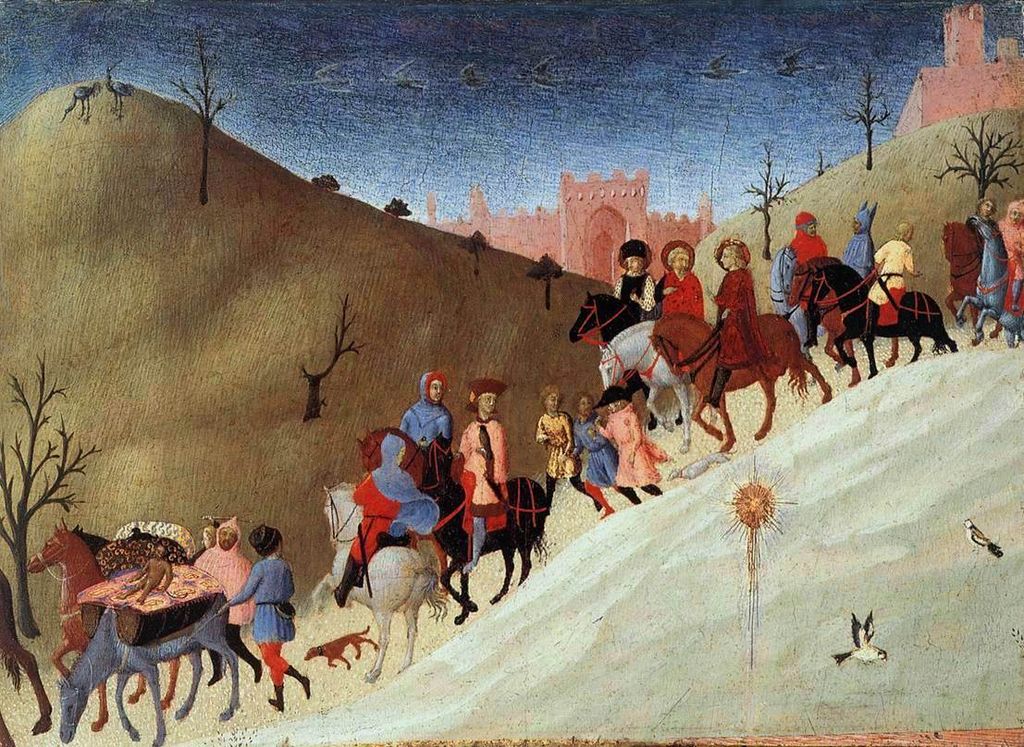
It is unknown if there were only 3 wise-men. Later church traditions ascribe names to these wisemen: Gaspar, Melchior, and Balthasar.[3]However, it’s unlikely there were only 3 because a few dudes on a camel wouldn’t necessarily alert Herod’s attention. [4] These were more likely a caravan and multitude of magi to protect their expensive gifts as they travel to deliver them to their intended destination.
From where did the magi come?
Matthew describes the magi arriving from the east. Four possibilities: Parthia/Iran, Babylon, Arabia, or Egypt.[5] Biblically speaking, we can discern a Jewish community settled in Babylon, where the prophet Daniel oversaw and influenced Gentile magi (cf Dan 2:48; 5:11).
Specifically, these magi are Gentiles who study the stars with spiritual knowledge. While Scripture delineates between astronomy (Ps 8; 19; 148; etc.) and astrology (cf. Jer 8:2; 19:13; Isa 47:13-15), the latter being warned against, God spoke to these Gentiles in a way they could understand. Thus, Matthew is emphasizing the geographical expansion of Jesus’ salvation beyond Israel for a new people of God.
The opening chapters of Matthew’s Gospel is emphasizing the geographical expansion of Jesus’ salvation beyond Israel for a new people of God. Jesus wants disciples of all nations.
What was the magi’s aim?
Matthew states that the magi followed a star to enter the capital city of Jerusalem. Scholars are uncertain whether this was an astrological phenomenon like a comet (Halley’s passed in 12-11BC), a supernova (exploding star), or conjunction of planets (Jupiter and Saturn aligned in 7-6BC).[6] It’s also possible that the star was an angel or heavenly host.[7]
Nonetheless, they were looking for the one born king of the Jews because they wanted to worship him. The title of the one they’re seeking has both political and spiritual expectations as they were among Jews expecting a military Messiah to deliver them from Roman rule with King Herod.
Matthew describes their worship (2:10-11), and we can reflect upon questions for our own perspective of worship.
- They rejoiced exceedingly with great joy.
> Why does it seem like our worship is more like duty or obligation rather than delightful opportunity? - They went into the house and saw the child.
> Why do we resist gathering, thinking worship from home, or going about Sunday busyness is equally valid and meaningful? Sometimes online worship experiences can be a temporary substitute for health or travel, but we should not neglect to enter the house with the people of God. We will miss seeing, hearing, feeling, and receiving blessings from God when we choose not to go inside and gather. - They fell down and worshiped. Notably, the worship of Jesus is highlighted in Matthews Gospel no less than 10x.[8] Falling or bowing down is a posture of reverence. What does your posture say about your worship?
- They opened their treasures and offered gifts. They had 3 gifts to present to Jesus and His family.
- Gold. Obviously, a precious metal that expressed appreciated value and a noble gift. We know that when Joseph & Mary presented Jesus in the temple with a sacrificial offering, they chose a gift representative of poverty (cf. Lk 2:24). Thus, another reason to discern the magi with their gift of gold arrived at date much removed from Christ’s birth.
Overall, the gift of gold supported the newlywed couple as they started their family and were later forced to flee their homeland due to national terrorism.
> What’s a noble gift you can offer God? It may be financial, or could simply be time invested serving. Either way, our worship of God is not to be half-way or half-hearted.
- Frankincense was a fragrant spice that was generally used for medicinal purposes, but also religious practices by priests. [9] Undoubtedly, this gift was practical to care for an infant but also spoke to the priestly role of Jesus. Frankincense enabled the couple’s personal and communal worship practices. Therefore, this gift was also deeply spiritual.
> How does your worship inspire others to personal commitment and communal devotion? What aroma does your life attitudes and actions display to others? It is possible that people are not meaningfully interacting with you because your outlook is frequently negative and your conduct is intolerable? You don’t have to live lonely and embittered. The gift of frankincense is a reminder that God heals us with His intercessory care. We can change and live in the love of our Father.
- Myrrh was a resin powder with a fresh scent. The aromatic fragrance was used as a perfume (Es 2:12), as a laundry detergent (Ps 45:8) and used for embalming purposes (Jn 19:39).[10] There appears to be hints toward Jesus’ mission of His sacrificial death in this gift.
> How are you extending to others the fresh grace and motivating purpose found in the gospel?
APPLY/THINK
Matthew 2 identifies three approaches to worship: indifference, hostility, and devotion.[11]
- Indifference. The Jewish religious leaders knew the Scriptures of where to look for the Messiah’s birth. They knew God’s promises but they failed to be attentive. They were indifferent, and many missed the joy of Jesus and the forgiving grace of the gospel.
If this is you, would you pray for God to open your heart to breathe life, fire, and spiritual passion into your soul? - Hostility. Herod’s approach to Jesus as king was hatred, extremism, and violence. There are many people who rebel against Christianity not because of rational beliefs but emotional outlooks. They respond to Christian kindness with suspicion and faith ideas with argumentative discussion.
If this is you, we agree that many claims of Christ are challenging. But we also believe that a God who never demands anything from us, or never requires us to change, and affirms all of our personal priorities and political preferences is one produced in our image and not us in His.
It’s possible we are like Ebeneezer Scrooge who needs to be confronted with self-examination and a dosage of eternal perspective.
So, if this is you, please continue attending SPBC to explore Christianity and discover if biblical truth and gospel grace is sufficient to meet you where you are and begin making a meaningful difference in your life. - Devoted. The magi were diligent in their study, undeterred in their pursuit, and generous in their worship with gifts to Jesus.
Further, the magi were attentive to God that He warned them in a dream not to return to Herod and to return home via a different path.
The same is true for everyone who encounters Jesus – they return home differently.
We cannot go unchanged after we meet Jesus.
Overall, the magi recognize that any gift does not perfectly fit the newborn king. We don’t give kings what they need because kings already possess what is at hand. Kings are sovereign and powerful, often with very little needs. Instead, we give to kings out of the overflow of our heart, because while kings demand allegiance, the gift they don’t have is our affection.
Like the Little Drummer Boy, we are unworthy, undeserving sinners without means to bring a gift except what’s in our hand.
So, tonight, we start with an empty candle and after it’s lit will offer light and hope to someone else. Take your little and give it to God, and watch Him push back the darkness.
[1] See Matthew 2:8, 9, 11, 13, 14, 20, 21.
[2] Donald A. Hagner, Matthew 1–13, vol. 33A, Word Biblical Commentary (Dallas: Word, Incorporated, 1993), 27.
[3] Craig Blomberg, Matthew, vol. 22, The New American Commentary (Nashville: Broadman & Holman Publishers, 1992).
[4] Daniel M. Doriani, “Matthew,” in Matthew–Luke, ed. Iain M. Duguid, James M. Hamilton Jr., and Jay Sklar, vol. VIII, ESV Expository Commentary (Wheaton, IL: Crossway, 2021), 57.
[5] Donald A. Hagner, Matthew 1–13, vol. 33A, Word Biblical Commentary (Dallas: Word, Incorporated, 1993), 27.
[6] Donald A. Hagner, Matthew 1–13, vol. 33A, Word Biblical Commentary (Dallas: Word, Incorporated, 1993), 27–28.
[7] Cf. Gen 28:12; Ex 14:19; 23:20; Mt 28:1-2; Ac 10:30; 12:7; Eph 1:20-21; Col 1:13; Rev 18:1; etc.
[8] Leon Morris, The Gospel according to Matthew, The Pillar New Testament Commentary (Grand Rapids, MI; Leicester, England: W.B. Eerdmans; Inter-Varsity Press, 1992), 37. See Matthew 2:, 8, 11; 8:2; 9:18; 14:33; 15:25; 20:20; 28:9, 17.
[9] Leon Morris, The Gospel according to Matthew, The Pillar New Testament Commentary (Grand Rapids, MI; Leicester, England: W.B. Eerdmans; Inter-Varsity Press, 1992), 41.
[10] Chad Brand et al., eds., “Myrrh,” Holman Illustrated Bible Dictionary (Nashville, TN: Holman Bible Publishers, 2003), 1163.
[11] Inspired from Charles R. Swindoll, Matthew 1–15, vol. 1A, Swindoll’s Living Insights New Testament Commentary (Carol Stream, IL: Tyndale House Publishers, Inc., 2020), 38–39.
 Growing Godly Generations