This month we’ve talked about characteristics of a good friend and how to find/be a good friend. We explored two Bible passages with brief insights as shared below.
1) Proverbs (various)
- A constructive friend: brings out the best in you; they build up (cf Prov 12:26; 13:20; 19:20; 27:17). Contrast with a destructive friend… start with laziness who repeats negative behaviors and doesn’t act to correct or change toward positive characteristics.
- A compassionate friend: gentle, generous, and gracious; they stay with you even through hardship and help you to overcome problems. (cf Prov 17:17; 22:24). Contrast with a repeatedly angry and conflicting friend who lashes out instead of manages conflict constructively (cf Prov 22:24).
- A Christ-centered friend: models character, faith, and eternal mindset. They help you to grow in faith. (cf Prov 3:1-6; 18:24)
2) Ruth. This short narrative book is a fascinating study and discussion on friendship and intergenerational relationships. Concepts of Loyalty, Grace & Faith, God’s kindness.

What can parents do to help their children cultivate healthy friendships?
Below insights are discussion points in brief outline form that we discussed and elaborated together as a church family and Christian parents.
- Know friendships are fundamental to life (Gen 2:18). Loneliness is epidemic and social media hurts more than helps. Take this seriously.
- Start with listening. Listen to the aims, concerns, and frustrations your teen is having with friends.
- Share from your experiences and insights; be appropriately vulnerable so your teen sees you genuinely care and also learns from your mistakes. Do be careful about oversharing in certain moments that are about the teen rather than your past issues or present “therapy.”

- Friendships are hard because people are complex. Not every friend will be true or forever. People will disappoint us and there is only one Savior.
- Teach how to ask questions and practice conversations. First impressions and introductions are helpful to begin a friendship.
- HEART: Hello Entertainment Activities Relationships Treasure
- Reframe conflict as not always negative. Conflict means people care about something and remind us not everyone is the same. Our differences don’t have to mean disconnection. Teach and model healthy conflict skills.
- You/Me/We to rotation discussion
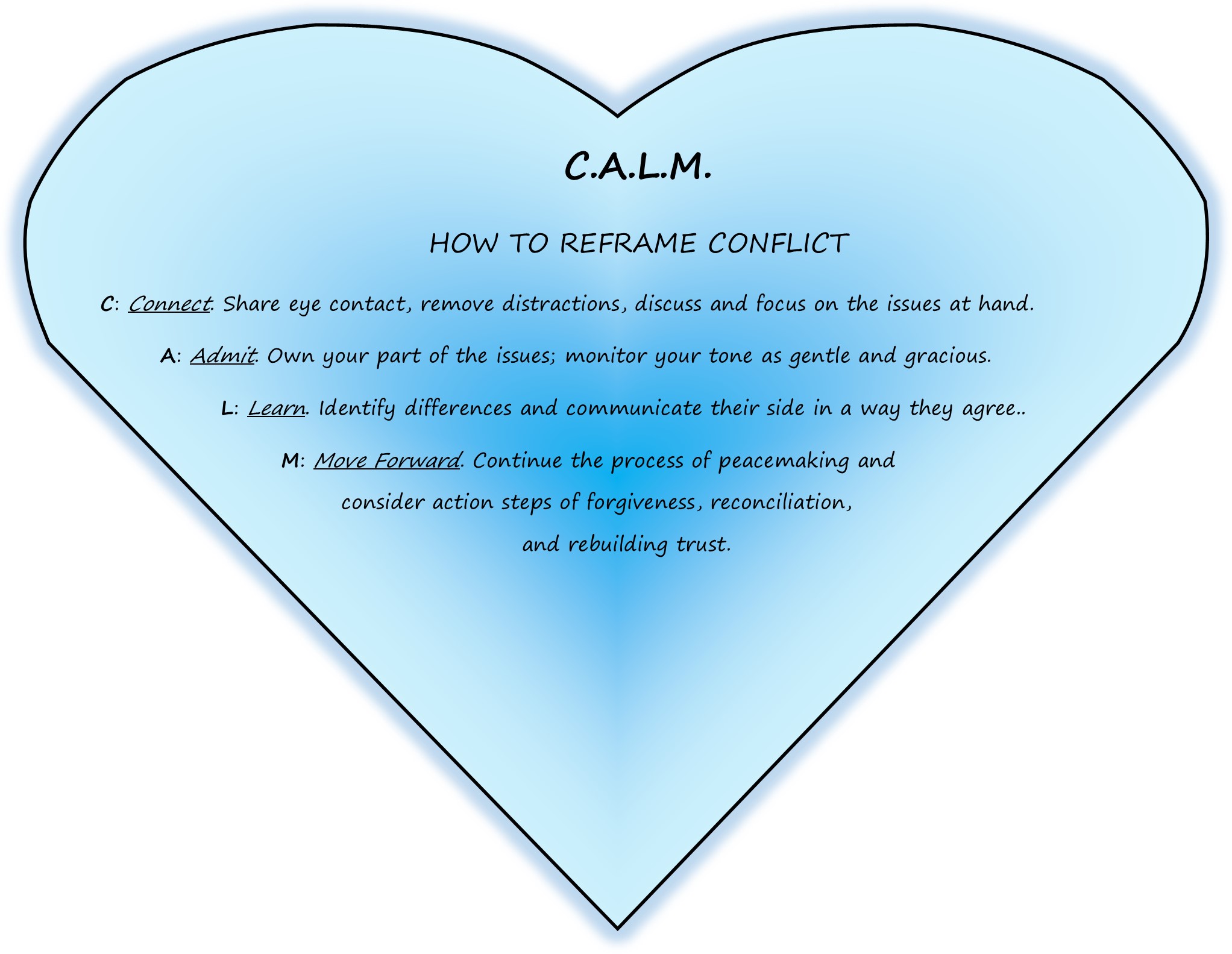
- CALM:
Admit
Learn
Move forward
- Provide environments and opportunities for your child to make friends, establish positive peers, and discover intergenerational influences.
– Plan interactive gatherings: food, parks, bowling, mini-golf, go-cart, mall shopping, etc. (theatre is bottom of list)
– Connect with neighborhood and community happenings
– Participate in activities: sport teams, music/art clubs, stem groups, scouts, etc.
– Commit to a church… don’t just appear but apply your time and life there as a priority. See Proverbs 13:20; Acts 2:42; Hebrews 3:12-14; 10:24-25
- Pray about your child’s friendships and with your child to form friendships.
- Parent for the future. It is very easy to get discouraged about past mistakes or present episodes. Play the long-game. Start afresh and persevere with God’s grace and truth. A parent’s goal is not just raising children but developing adults to be independent from you.
What feedback or questions do you have?
- Some resource links to books, articles, sermons on Christian parenting: https://growinggodlygenerations.com/2015/02/07/christian-parenting-resources/
 Growing Godly Generations