video forthcoming
MOTIVATE
Most of us can’t remember when we took our first steps. But, especially if you’re a parent, you can remember helping your child take their first steps. (those not parents have seen the circus, ha!)
- Holding their hands high and scooting along
- Holding or leaving a trail of food…
- Sitting across coaxing & clapping “C’mon”
- Some steps swiftly turned into a crawl… but
- Each step was celebrated until there became running toward every sharp object and hard surface. Then you realized they needed more guidance on when and where to go.
Then came teaching how to ride a scooter, a bicycle, roller blades, ice skating… then a car, and onward. Teaching others, whether a child or not, to develop skills is the joy of relationships.
And this is what separates Christianity from all other religions. Whereas religions provide a list of practices for perfection or pathway to enlightenment, Christianity simply offers a person: Jesus. Jesus says, “follow me.” Thus, Christianity is a relationship of being in the presence of love and shared life with the only way our faith relationship grows is a series of crawls, steps, falls, and daily getting back up.
And curiously, Jesus isn’t afraid to invite the unskilled or the undesirable to join the journey.

EXAMINE Matthew 9:9-13
9 As Jesus passed on from there, he saw a man called Matthew sitting at the tax booth, and he said to him, “Follow me.” And he rose and followed him. 10 And as Jesus reclined at table in the house, behold, many tax collectors and sinners came and were reclining with Jesus and his disciples. 11 And when the Pharisees saw this, they said to his disciples, “Why does your teacher eat with tax collectors and sinners?” 12 But when he heard it, he said, “Those who are well have no need of a physician, but those who are sick. 13 Go and learn what this means: ‘I desire mercy, and not sacrifice.’ For I came not to call the righteous, but sinners.”
Jesus invites sinners to discipleship (9:9).
Undoubtedly, Jesus’ teachings and actions have been creating a stir in the region.
- His teachings contain not just information and ideas but authority.
- His ability to heal mind, body, and soul of those suffering. Further, the miracles were drawing masses.
- His attraction beyond religious Jews to those marginalized and outcast.
- His attack on social structures and human comforts where people find their identity.
Jesus continues His methods of disciplemaking by inviting a man on the fringe and one disenfranchised by his own – Matthew, the tax collector – to follow.
Matthew is a personal name, which means “gift of Yahweh.”[1] In the other Gospels, Matthew is also known as “Levi” (Mk 3:18; Lk 6:15; Ac 1:13). The latter name had Jewish roots with one of Israel’s sons/tribes (cf. Gen 49:5). Matthew was the son of Alphaeus, which potentially makes him a brother to another disciple James (Mk 2:14). And then their mother, Mary is a close follower of Jesus, even at Jesus’ death (cf. Mt 27:55-56).
Further, Matthew is a tax collector. This is a last credential one would expect to be on team Jesus. Tax collectors were viewed in the same way as prostitutes, addicts, and evil politicians (cf. Mt 11:19; 21:32). Tax collectors were despised in Israel because they were on team enemy. They not only collected money for Rome but they extorted money from citizens to feed their greed.
- Equivalent of tax collector taking your money and sending it to H@m@s/Russ1@/Ch1n@.
And Matthew wasn’t a “chief tax collector” like Zacchaeus (cf Lk 19:2) but a regular worker who related to citizens face-to-face and forced payments on goods and services.[2] Thus, it was likely the disciples – fishermen – and Jesus, had troubled interaction with Matthew multiples times before. So, Jesus’ recruitment would undoubtedly impact team chemistry to say the least.[3]
Matthew’s daily life was likely one of conflict and hostility. He would have been banned from synagogue life and separated from his Jewish family. It’s probably he was a loner and afflicted soul.
Yet, we see Matthew’s characteristics and life circumstances were obviously redeemed. Matthew’s attention to detail and abilities with numbers, combined with knowledge of OT Scriptures was legendary to relate to Jesus’ fulfillment of prophecy.
Whereas the other disciples always had a fallback plan from following Jesus, Matthew was all-in and could never return. [4] Matthew’s dropping a prosperous career shows us Jesus is a treasure worthy of all we have. Church traditions express that Matthew became an apostle as far as Ethiopia and was likely a martyr.[5]
Overall, the fact that Jesus invited Matthew to become a disciple means there’s grace for anyone. Whether you feel awkward at church, an outsider to faith, or excluded and like you don’t belong, Jesus says otherwise.
- Make people gasp while you
walkrun to grace. - Don’t allow fears of what others will say stop you from hearing what God has designed for you.
Jesus invites sinners to friendship (9:10-11).
Matthew’s response to follow Jesus, almost immediately, resulted in Jesus being hosted at a dinner party in Matthew’s house. Matthew’s guests included other tax collectors, scoundrels, and sinners because these were his only friends. Luke 5:29 describes the party as a “great feast with a large company.” Additionally, Mark 2:15 indicates Matthew’s friends were following Jesus too.
We should notice that Matthew doesn’t leave his luxury position with grim resignation. Instead, he joyfully cares and generously spends to help his friends encounter Jesus.
Jesus’ acquaintances and relationships gave Him the reputation of a “friend of sinners” (Mt 11:19). And this upset the religious establishment who worked tirelessly to communicate social standards and moral values. Jesus was contaminating the faith community by befriending sinners and inviting them to join the faith journey. So, the Pharisees wasted no time questioning the disciples with intent to condemn Jesus. “Why does your teacher eat with tax collectors and sinners?”
You’ll notice this is not really a question as much as an accusation.
- It’s like when your mom asks “Is your room clean?”
- Or when wife asks, “Did you finish that house project?”
- Or husband asking “What did you do all day?” not realizing that caring for tiny humans, calculating knowledge for various subjects to help each child with school homework, not to mention laundry for people who live like they work in a greasy garage, and attempting to make food for a thankless army of “staaaarving” children, takes heaping amounts of time.
- Or when your boss says, “How much work do you think we can get done this week?”
These questions are seldom honest curiosity as they are hostile condemnation.
It must be noted that table fellowship in biblical culture symbolized closeness and acceptance.[6] Jews were not permitted to eat with Gentiles. In fact, the word for “sinners” is close to another word “Am-ha-aretz” which means people of the land. [7] So, the Pharisees were not just focused on religious laws but ethnic differences. Yet, Jesus previously described the heavenly kingdom’s banquet with “many coming from east and west to recline at table with Abrham, Isaac, and Jacob, while the sons of [Israel] will be thrown into outer darkness with weeping and gnashing of teeth” (Mt 8:11-12).
Thus, Christians certainly need a band of brothers and soul sisters with shared faith. And, undoubtedly, “bad company corrupts good character” (1Cor 15:33). Yet, Christians are not taken out of the world but in the world to be salt and light.
Christians need to spend time with people who think and talk differently, and in places that make us uncomfortable. Jesus, the friend of sinners, models for us how to spread faith without compromising faith convictions. We must balance alienating unbelievers while not affirming sinful behaviors; it’s the balance of truth and love that comes alongside unbelievers as fellow sinners leading them to loyal love based upon uncompromising principles.
- Who is at your dinner table? Goal for monthly meeting neighbors & co-workers with 1 act of service 1 shared experience (convo/meal/together)
We must balance alienating unbelievers while not affirming sinful behaviors; it’s the balance of truth and love that comes alongside unbelievers as fellow sinners leading them to loyal love based upon uncompromising principles.
Jesus invites religious sinners to understand mercy (9:12-13).
Back to those Pharisees – they valued being expert teachers of religious laws. They asked the disciples about their teacher and accused their teacher of flaws for relating to unclean Gentiles. But Jesus promptly responds: “You [Pharisees] need to go and learn the OT since your teachers didn’t properly explain truth.” Jesus quotes from Hosea 6:6 ‘I desire mercy, and not sacrifice.’ Jews followed the sacrificial system but they mixed worship with idols and trusted political alliances, committing spiritual adultery {remember Hosea series?[8]}. And more they mistreated people with lies, theft, and bloodshed, whereas God instructed them to be compassionate and gracious.
Jesus never denies the dinner guests were sinners. BTW, this term was like a catch all term that included everything from lying, violence, fornication, adultery and anything in between.
Jesus explains, taking a simple illustration from everyday life about a sick person going to a doctor. Jesus says: “Those who are well have no need of a physician, but those who are sick. For I came not to call the righteous, but sinners.” If a physician never interacts with sick or hurting patients, then they’re a pointless physician. Just as unhealthy people need a physician, so spiritually lost people need a Savior. Jesus’ life mission was to extend God’s mercy to messed up and broken sinners.
How can religious people, who have tasted the Lord’s goodness and received His forgiving grace, look down or exclude others from friendship and faith opportunities? Why would believers not be burdened with spiritual lostness and offer life to people heading toward eternal darkness?
The summary application is to remind us that we are not reading the Bible and gathering to merely satisfy our religious itch. We open our Bibles to learn but we also open our life to love others in the name of Jesus. Sadly, many Christians are educated beyond their obedience. Their faith is relying upon facts about Jesus but missing application, which James says, “faith without works is dead” (J 2:17).
- When you gather publicly, come to give and not just get… excuse the wording… but don’t be a constipated Christian! Look for opportunities to speak to people – especially new or unknown individuals. Write down their names and/or their needs so you remember to pray for them, and consider how to serve or connect them to others.
APPLY/THINK
Jesus invites sinners to discipleship (9:9).
Jesus invites sinners to friendship (9:10-11).
Jesus invites religious sinners to understand mercy (9:12-13).
- Start with Jesus. If you feel like Matthew who has surrounded your life with earthly distractions and indulgent comforts, Jesus offers something more. Listen to His voice and follow. No one is too far from God or too big a sinner that God can’t save.
- Start at Matthew’s table. Reach those God has placed right in front of you. Seriously, Matthew’s immediate response to Jesus was to rally his friends to meet Jesus. What holds us from inviting persons to church and gospel conversations?
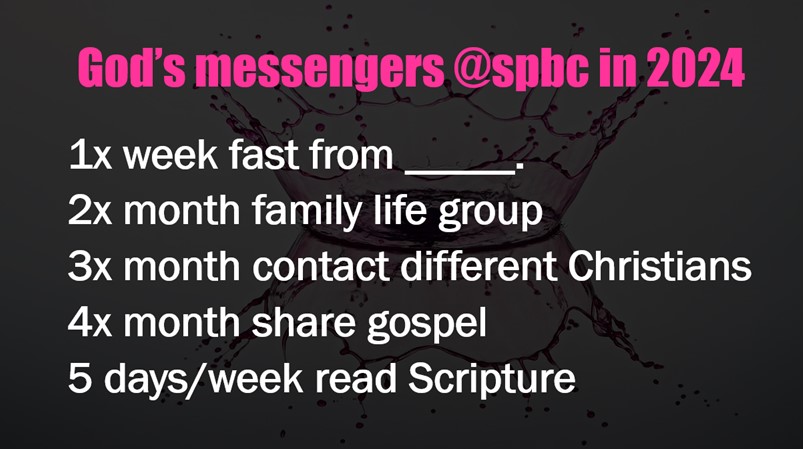
- Restart with our 2024 goals
[1] Oscar S. Brooks, “Matthew,” ed. Chad Brand et al., Holman Illustrated Bible Dictionary (Nashville, TN: Holman Bible Publishers, 2003), 1090.
[2] See John MacArthur, 12 Ordinary Men, p.180.
[3] This is where The Chosen, perhaps can illustrate and speculate certain dynamics of the biblical text.
[4] Leon Morris, The Gospel according to Matthew, The Pillar New Testament Commentary (Grand Rapids, MI; Leicester, England: W.B. Eerdmans; Inter-Varsity Press, 1992), 219–220.
[5] Donald A. Hagner, Matthew 1–13, vol. 33A, Word Biblical Commentary (Dallas: Word, Incorporated, 1993), 237.
[6] Donald A. Hagner, Matthew 1–13, vol. 33A, Word Biblical Commentary (Dallas: Word, Incorporated, 1993), 238–239.
[7] Craig Blomberg, Matthew, vol. 22, The New American Commentary (Nashville: Broadman & Holman Publishers, 1992), 156. Also, https://www.thegospelcoalition.org/themelios/review/none-but-the-sinners-religious-categories-in-the-gospel-of-luke-jsnt-supplement-58/
[8] https://growinggodlygenerations.com/2023/09/03/relentless-grace-hosea-1-2/
 Growing Godly Generations