MOTIVATE
Our house is a flag lot. A flag lot means the house does not have road frontage but contains either a longer driveway or entering a side access road to reach the house. Our house has a long driveway and sits back off the neighborhood road, and it’s surrounded (shielded) by 6 other homes, along with several pine and oak trees.
Recently, we had a tree company to our property to remove 5 trees that were dead, and trim branches to several others. Last year we had several branches fall, with one significant to damage our deck and siding.
Trees need attention and care to remain healthy. And sadly, in many states, Maryland included, oak trees are dying at a significant rate. Oak Wilt is a disease named after the wilting leaves of dead trees. It comes from a fungus that grows on trees, which attracts beetles and insects to eat. Eventually, the fungus spreads and even grows underground to impact other trees. Also, the insects carry the fungus to other healthy trees. Overall, it’s difficult to prevent and stop the spread of diseased trees.
The result is property becomes bare with visible emptiness of a once landscaped area with beautiful trees. It’s also very expensive to remove trees. Additionally, the damage of fallen branches can destroy property, or worse if individuals are near a collapse.
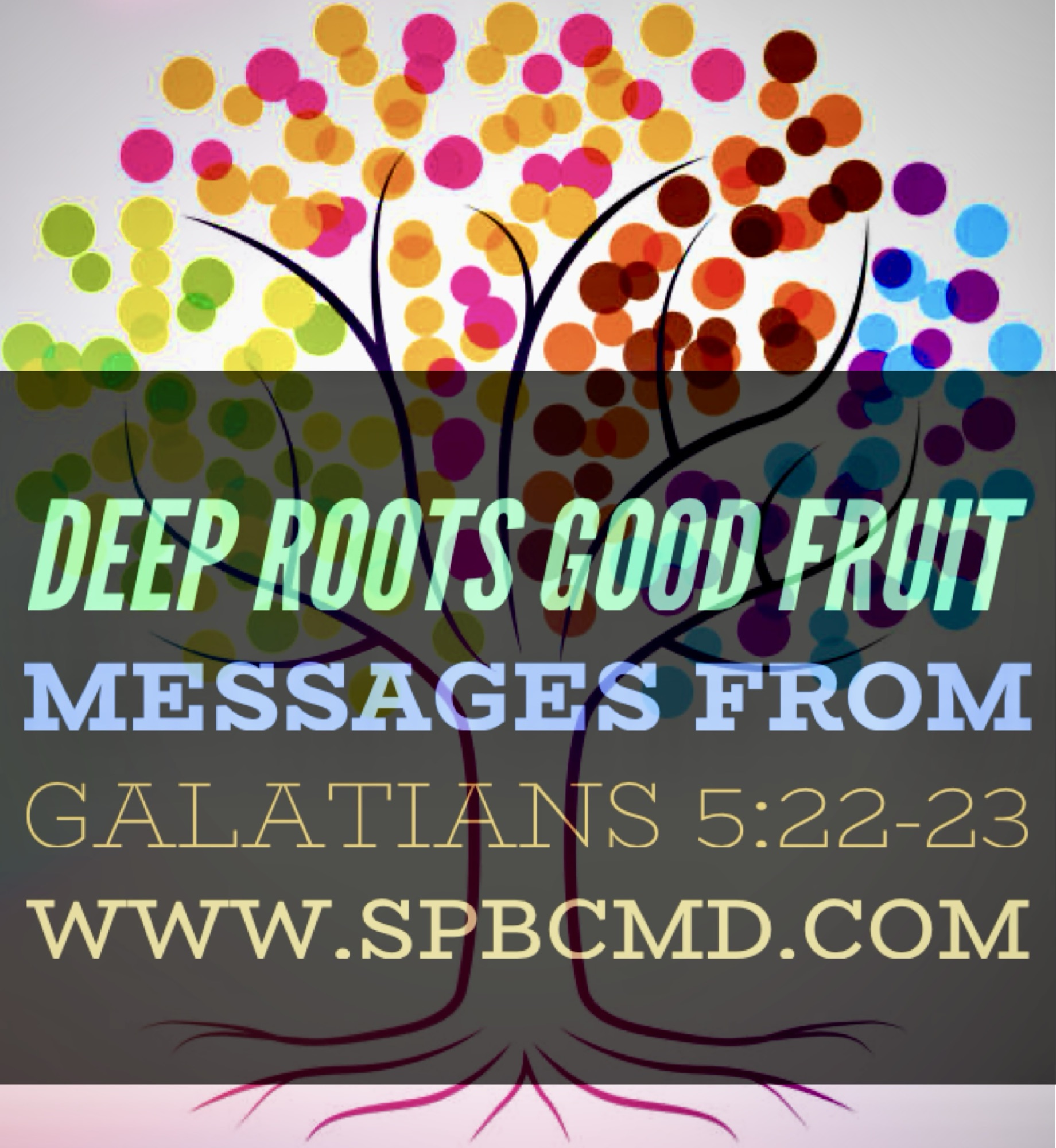
This is a picture of our message series discussing life in the flesh vs life in the Spirit. Life in the flesh is susceptible to a spreading fungus that can spoil fruit, cause untold and costly damage, and choke the spiritual life from individuals, families, churches, and communities.
But life in the Holy Spirit is a vibrant and visible representation of Jesus. The Spirit inspires sincere love, effervescent joy, encompassing peace, discerning patience, supportive kindness, effective goodness, enduring faithfulness, impactful gentleness, and principled self-control.
So, let’s begin with some introductory comments about the fruit of the Spirit.
EXAMINE Love Galatians 5:22-23
- Fruit is sobering. This series is vital to being a sincere Christian, having a solid marriage and strong family, and being in a sound and faithful church. It’s also very humbling because we cannot produce this on our own.
- Fruit has a source: the one connected to the Holy Spirit. And the Holy Spirit is only present in the follower of Jesus. Jesus said, “I am the vine, you are the branches. Abide in me and you will bear much fruit. Apart from me, you can do nothing.” (Jn 15:5)
So, the Christian life is not about “doing better” or “try harder” to add these fruit in your life. Sadly, that’s a far too common way of thinking and teaching in churches… These are not traits we can do on our own, nor are these merits toward God.
It is possible you may have some of these fruit reflective in your life, but you will never flourish with all of them and produce them as fully as you should without being connected by grace to Jesus.- And feeding the flesh with sexual immorality, impurity, sensuality, idolatry, sorcery, enmity, strife, jealousy, fits of anger, rivalries, dissensions, divisions, envy, drunkenness, orgies, and things like these will quench and choke the Spirit.
- And feeding the flesh with sexual immorality, impurity, sensuality, idolatry, sorcery, enmity, strife, jealousy, fits of anger, rivalries, dissensions, divisions, envy, drunkenness, orgies, and things like these will quench and choke the Spirit.
- Fruit is singular not plural. Specifically, you cannot pick and choose one over the other. All of these should be growing in our life, or it may indication of something unhealthy in our spiritual life.
- So, use this series as a mirror to your soul. Pray for the Spirit to help you surrender – He increase, flesh decrease.
22 But the fruit of the Spirit is love, joy, peace, patience, kindness, goodness, faithfulness, 23 gentleness, self-control; against such things there is no law. 24 And those who belong to Christ Jesus have crucified the flesh with its passions and desires. 25 If we live by the Spirit, let us also keep in step with the Spirit.
Love is often misunderstood in our society. We use the word liberally in the same breath as loving French fries or family members. It’s quickly used for surface relationships and “hook-up” culture, while also used to describe a couple’s faithfulness in marriage for multiple decades. But surely there is a depth and profundity to love than what is haphzardly spoken.
The Bible is helpful and invaluable to understand the meaning of love.
The first context the word love appears is in Genesis 22. Yahweh has made a promise to a man named Abraham. God’s promise was to make Abraham’s offspring be as many as sands on the shore and to bless all nations. Just one problem: Abraham and his wife Sarah got stuck sitting in the Cracker Barrel rocking chairs. Seriously, they were elderly and without offspring. But God’s promises always come true. So, when Abe was 100 and Sarah was 90, they had a son named Isaac; whose name means: “He laughs.” You can probably guess why. But you can imagine the love these age-defying parents had for Isaac.
Then one day, God tested Abraham: “Take your son, your only son Isaac, whom you love, and go to the land of Moriah, and offer him there as a sacrifice. So Abraham rose early in the morning, saddled his donkey and too two of his young men with him, and his son Isaac. And he cut the wood for the sacrifice and arose and went to the place of which God had told him… Then coming upon the place, Abraham told his servants, ‘Stay here while I and the boy go worship, and we will return” (Gen 22:2-5)
We know this familiar story. Abraham immeasurably loves his son, but is willing to give his life to God. God sees Abraham’s faith and provides a sacrificial ram instead of Isaac.
So, we learn that love is not a temporary feeling but fully trusting another. Abraham trusted God to spare his son, even though he wasn’t certain how. Love is willing to give up what it can’t keep to gain what it can’t lose. Love endures challenges and believes the best is always possible.
Love is not a temporary feeling but fully trusting another person. Love is willing to give up what it can’t keep to gain what it can’t lose. Love endures challenges and believes the best is always possible.
Tweet
God’s people are commanded to love God with all their heart, soul, mind, and strength (Dt 6:5), because the LORD loves us first (Dt 7:7-9; 1Jn 4:19).
And we see this type of love modeled and amplified for us in the life of Jesus.
- My personal goal for next few months is to read Gospels each month.
- Momentum will spend 7+ sessions
- J40 in 2026
- We want to avoid being vague “Christians” but specific Jesus followers who profess Jesus with lips and promote Jesus with our life – – – enough that if it were a crime to be a Christian, the evidence of the fruit of the Spirit would be overwhelming to convict us of such an infraction.
So, when Jesus enters the world, we see love incarnate.
- Jn 3:16 “For God so loved the world, that he gave his only Son, that whoever believes in him should not perish but have eternal life.”
- Love your neighbor and those who differ from you, even enemies
(Lk 6:32-35). - Jesus had overwhelming love and compassion for people, viewing them as sheep w/o a shepherd (Mt 9:36)
- Jesus loved with grief. Upon the news of a close friend dying, Jesus shows us how to love with tears and hope (Jn 11:35-36).
- Jesus loved with the full measure.
JOHN 13
1 Now before the Feast of the Passover, when Jesus knew that his hour had come to depart out of this world to the Father, having loved his own who were in the world, he loved them to the end.
2 During supper, when the devil had already put it into the heart of Judas Iscariot, Simon’s son, to betray him, 3 Jesus, knowing that the Father had given all things into his hands, and that he had come from God and was going back to God, 4 rose from supper. He laid aside his outer garments, and taking a towel, tied it around his waist. 5 Then he poured water into a basin and began to wash the disciples’ feet and to wipe them with the towel that was wrapped around him.
When Jesus neared the end of his life, he loved them εἰς τέλος. It’s not just a chronological end, but Jesus’ love had a purpose with momentous examples: washing feet, and then later sacrificial death.
We need not spend too much time discussing foot washing. We’ve done so in other sermons, and you understand the impact. A supremely worthy king washing the dirty feet of ordinary and unqualified disciples; disqualifying to Judas the betrayer! It’s unheard care and affection; radical servanthood and life-transforming love in action.
This account is not included in the other Gospels, but it was with John. Why?
Well, remember who was John? He was known as a “son of thunder” (Mk 3:17). An example of John’s character is revealed in Lk 9:54, when John wants Jesus to call down thunderous judgment upon people who didn’t follow Jesus. This sort of intense zeal is often fiercely stubborn and arrogantly unchanging. But John encountered Jesus. And John’s writings include the word “love” 116x, often in reference to the unshakeable and undeserving love of God that changes a child of thunder into a person of peace.
In fact, Jesus expects this of His followers.
Jn 13: 34 A new commandment I give to you, that you love one another: just as I have loved you, you also are to love one another. 35 By this all people will know that you are my disciples, if you have love for one another.”
1 John 4:7–8, 20 “Dear friends, let us continue to love one another, for love comes from God. Anyone who loves is a child of God and knows God. But anyone who does not love does not know God, for God is love… If anyone says, ‘I love God,’ and hates another, they are a liar, for those who do not love others who they can see cannot love God whom they have not seen. Whoever loves God must love others.”
Love is the convincing characteristic of one who follows Jesus. It’s how people who are looking to discover Jesus find Him today – they encounter people who actually love like Jesus.
Love is the convincing characteristic of one who follows Jesus. It’s how people who are looking to discover Jesus find Him today – they encounter people who actually love like Jesus.
Tweet
APPLY/TAKEAWAY
How do we cultivate the fruit of love?
See people.
God is known as “El-Roi” the God who sees (Gen 16:13). God’s vision turns into action to redeem and rescue. Likewise, we must see people like a lifeguard who diligently scans the water for people in danger of drowning, so we must be aware of others we encounter. Christians need to be neighbors who notice, and noticing starts with being available.[1] Some simple action steps for being available is eat outside, take walks around your neighborhood, and at the very least to introduce yourself to neighbors if you don’t know them. Even if you are not an extrovert, you can still make observations for what needs could be met in the name of Jesus.
Christians need to be neighbors who notice, and noticing starts with being available.
Tweet
Show hospitality and serve needs.
When we see people through the eyes of Jesus, we are compelled to action. Love acts, it cooks/bakes, it calls, it writes, it drives, it gives, it goes, it serves, it sends.
The word hospitality (φιλοξενία) means a love for outsiders/ different/ strangers/ guests.[2] And hospitality was a basic element of early Christianity.
- Ac 4:32 “the full number of those who believed were of one heart and soul, and no one said that any of the things that belonged to them was their own, but they had everything in common – there was not a needy person among them”
- Ro 12:13 “Contribute to the needs of the saints and seek to show hospitality.”
- 1 Pe 4:9 “Show hospitality to one another w/o grumbling.”
- 1Tim 3:2/Ti 1:8 hospitality is characteristic for elders
- Heb 13:2 “Do not neglect to show hospitality to strangers, for thereby some have entertained angels unawares.”
There are many barriers to showing hospitality and serving needs. Here are a couple:
- Busyness. Our culture views multi-tasking and full calendars as normal, even admirable. But the pace of our lives wrecks the best of intentions. We say we care about others, but we simply have little time for relationships. “I’m busy” somehow equals “I’m important,” but it misses the priority of people in our life that we can’t get back time that is missed.
> Create margin on a daily/weekly basis to allow for relationships to develop. - Shallowness. We’re not shallow on purpose, and many of us are likely unaware that the majority of our relationships stay on the surface. We wish for deeper connection, but we’re either uncertain how to get there, or perhaps we’ve been betrayed before that makes us withhold being vulnerable or sharing anything in depth – or asking deeper questions of others.
> Tell people inside your home how much you love them. Perform an action that they would perceive you notice them and care for them.
> Tell people outside your home how much you value them. Celebrate together. Ask of their challenges, then pray together.
Speak forgiveness.
Psychologists and social workers indicate that an overwhelming percentage of relationships are dealing with unresolved anger and harboring unforgiveness. We know we should forgive, but somehow we hold on to negativity and bitterness.
If we’re going to people known for the love of Jesus, then we must learn how to forgive and entrust people to God. Jesus taught that if we withhold forgiveness, then our daily prayers and weekly worship is in vain (Mt 5:23-26; 6:14-15). We must remember we are sinners first before we are sinned against. And since we are forgiven much, we can forgive much (Lk 7:47).
If we’re going to people known for the love of Jesus, then we must learn how to forgive and entrust people to God.
Tweet
Substitute cheap love with costly grace.
We often love with qualifications or conditions. We create contracts, establish terms and fine print, and if the agreement no longer satisfies or we find something better, then we easily end our relationship. Instead, Jesus shows us true love is not based on emotion or preference but upon character. And God’s character is perfect and holy; unlike ourselves.
God is love. And God’s love is not cheap but costly in the sacrifice of time and shedding of blood to the Son of God.
The only way we can begin to love others is to experience the love of God in our hearts.
So, today, we invite you to rest your soul on the love above all others: Jesus, the Rock of ages.
[1] For a message on the art of noticing: https://growinggodlygenerations.com/2021/02/01/gospel-neighbors-matthew-918-38/
[2] For a message on the art of hospitality see: https://growinggodlygenerations.com/2021/02/15/arts-of-gospel-neighboring-john-13/
 Growing Godly Generations