MOTIVATE
New Orleans is one of our nations prominent cities. Recently a terrorist attack occurred there with a truck driving through a crowded street of pedestrians that killed 15 people, injured several others, and caused a national uproar. Yet, days after events transpired showing the city’s culture and mindset:[1]
- A traditional brass-band parade down Bourbon Street
- Dinner reservations returned quickly at the historic French Quarter with throngs of tourists
- Designers and builders returned to put finishing touches on Mardi Gras floats
- One resident said, “It was very emotional [but] it’s time for resiliency and coming together.”
- Another resident and head of the city’s tourism marketing office, Walt Leger said: “There’s a lot of talk about resiliency – [referencing the city’s name as ‘The Big Easy” which has weathered many storms including catastrophic Hurricane Katrina in 2005 which killed more than 1,300].
YouWe get stronger and stronger with each challenge added to the list”
Our next series will be several weeks in Genesis. This is not a full book study like I taught in 2011. Instead, it’s a character study in the life of Joseph through the lens of a single word: resiliency.
Resilience derives from two words:
- Resilio: to rebound or bounce back
- ience: a state or quality; a mindset
So resiliency is the mindset of bouncing back, specifically through stress and challenges. It’s the capability of an object to experience a de-formation and to recover its size and shape.
Resiliency is the mindset of bouncing back, specifically through stress and challenges. It’s the capability of an object to experience a de-formation and to recover its size and shape. Ultimately, we know that resilience results from a relationship that abides in Almighty God.
Ultimately, we know that resilience results from a relationship that abides in Almighty God. God’s eternal presence and strength enable us to push back external forces to persevere and perform the calling that He has for our circumstances. The faith life operates in the reality that the one who began a work in us promises to bring it to completion.
We know there will always be pressure and problems, twists and turns. And the question is whether we will conform or cave? Resiliency is being aware and alert to our surroundings, and operating with the vision of what can be, not always what is at the moment; which requires the discipline of dependence upon the LORD in prayer and Scripture.
So, we turn attention to Gen37.

EXAMINE Belonging
1 Jacob lived in the land of his father’s sojournings, in the land of Canaan.
We need to understand the family dynamics. Jacob is Joseph’s father.
- Name = “heel grabber” or “deceiver”
- Aging man with weariness; like a car with a lot of mileage.
- Gen 27 Jacob steals brother’s birthright with mother Rebekah’s deceptive plot
- Gen 28 Jacob runs away from Esau and family
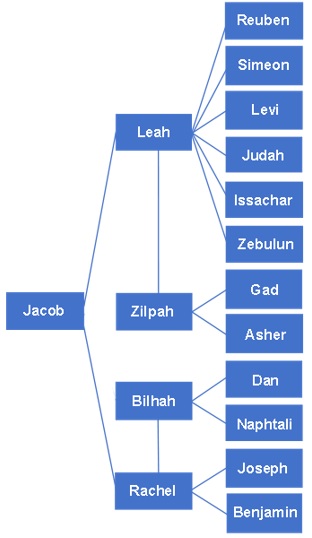
- Gen 29 J marries Leah AND Rachel after 14 years of labor. He flees family here too as family grows (graphic)
- Gen 32 on the run, J wrestles with God & gets a permanent limp in hip
- Gen 34 Jacob’s family dynamics were similar to his parents but worse: daughter with Leah Dinah gets raped. All her brothers go to village and slaughter the men. Jacob is angry but not about Dinah’s situation but his own public relations in the cities.
- Gen 35 Jacob buries Rachel & Isaac.
- Gen 35:22 after these family members die, Jacob’s son Reuben lays with father’s concubine. Jacob does nothing until end of life gives him a curse upon descendants (49:28; cf Judges 5:15-16).
- So, the background of this family is of dysfunction, deception, rivalry, rebellious violence, and traumatic depravity. This brings us to Joseph in Gen 37…
Joseph’s story occupies more space in Genesis than any other individual. There’s necessary instruction on his life (cf 1Cor 10:6-11).
2 These are the generations of Jacob. Joseph, being seventeen years old, was pasturing the flock with his brothers. He was a boy with the sons of Bilhah and Zilpah, his father’s wives. And Joseph brought a bad report of them to their father. 3 Now Israel loved Joseph more than any other of his sons, because he was the son of his old age. And he made him a robe of many colors.

Jacob had two wives: Leah & Rachel. He tolerated Leah but treasured Rachel. And Joseph (with Benjamin) were Jacob’s last connection to Rachel. So, now you understand why Joseph was the favorite. Jacob made Joseph a robe of many colors, scholars believe this was a long ornamental garment reaching out to the wrists and stretching down to the ankles.[2] And this set Joseph apart from the brothers, not to mention his father assigning him as a supervisor/spy/snitch about the brother’s behavior; which of course Joseph gives a bad report of them to their father.
And this is where we begin to understand a little about the need for resilience. The problems that Joseph and the brothers will experience are the byproduct of unhealed wounds from his father, and for Jacob with his father Isaac, and with his father Abraham.
Father wounds can occur in various ways:
- Father’s abuse being overly critical, controlling, or physically harmful.
- Father’s absence due to divorce, death, or neglect.
- Neglect can result in feeling abandoned from inattention, not affirming and providing love and leadership.
- Father wounds can also occur by over-accommodating. Raving too easily, rescuing too quickly, or risking too little can create a selfish and dependent child.[3]
Jacob wounded Joseph by overaccommodating. Yet, what we see is generations of family belonging one to another.
For good and bad, you belong to your family. Your journey to maturity is discerning how that sense of belonging shapes you. And while our family origin forms us, it doesn’t solely define us. We can be motivated in different ways to improve and develop towards a healthy and whole individual. This is what resiliency is all about.
For good and bad, you belong to your family. Your journey to maturity is discerning how that sense of belonging shapes you. And while our family origin forms us, it doesn’t solely define us. We can be motivated in different ways to improve and develop towards a healthy and whole individual. This is what resiliency is all about.
dave_dwb
4 But when his brothers saw that their father loved him more than all his brothers, they hated him and could not speak peacefully to him.
The brothers belonged to the family but by a different mother than Joseph. And while we are not certain, it appears Leah is deceased with Rachel by this point. So, Jacob is overaccommodating with Joseph but he’s wounding the other sons with his inattentiveness and critical eye
(more on that in a minute).
So the way the brothers respond to their father is being motivated by hate. The word “hate” appears 3x (vv.4, 5, 8). When words are repeated the author wants us to understand its significance. The brothers hatred is like growing kudzu that no matter how many times it gets trimmed back, it swells and surges with vengeance. The brothers are a contrast to Joseph: they were not resilient but ready to erupt like hot lava churning inside a mountain.
Life has a way of beating us up and breaking us down. And we can grow bitter instead of better. The brothers’ unhealed wounds made them easily annoyed, quick to be angry, and unprepared to act responsibly.
5 Now Joseph had a dream, and when he told it to his brothers they hated him even more. 6 He said to them, “Hear this dream that I have dreamed: 7 Behold, we were binding sheaves in the field, and behold, my sheaf arose and stood upright. And behold, your sheaves gathered around it and bowed down to my sheaf.”
Do you see the meaning? Joseph is strong and accomplished but the brothers are weak and will bow to their baby brother. It’s a dream to Joseph but nightmare for the brothers.
8 His brothers said to him, “Are you indeed to reign over us? Or are you indeed to rule over us?” So they hated him even more for his dreams and for his words. 9 Then he dreamed another dream and told it to his brothers
Joseph can’t get out of his own way. He’s not doing himself any favors by sharing his dreams with his brothers. You see, God was giving Joseph’s dreams – and that was good. But Joseph’s dreams from God were also a test from God, and Joseph was failing. Pride gets in the way of God’s promises and power. —> God has meaningful dreams and profound purposes for all of us, but be careful broadcasting your dreams before you’ve had time to discern God’s plan and timing, along with your intent for who will get the glory.
Joseph said, “Behold, I have dreamed another dream. Behold, the sun, the moon, and eleven stars were bowing down to me.” 10 But when he told it to his father and to his brothers, his father rebuked
You can tell Joseph’s pride is prominent because the favored son gets rebuked.
him and said to him, “What is this dream that you have dreamed? Shall I and your mother and your brothers indeed come to bow ourselves to the ground before you?” 11 And his brothers were jealous of him, but his father kept the saying in mind.
Joseph’s dream doesn’t just involve the brothers bowing but includes his father – and the reference to mother is curious since Rachel previously died (Ge 35:19) – but a) it’s possible to be a reference to Rachel’s maidservant Bilhah, who reared Joseph as his mother; and b) is indicative of why Jacob rebuked Joseph and denied the validity of the dream because Rachel’s death prohibited its fulfillment.[4]
12 Now his brothers went to pasture their father’s flock near Shechem. 13 And Israel said to Joseph, “Are not your brothers pasturing the flock at Shechem? Come, I will send you to them.” And he said to him, “Here I am.”
Ironically, Jacob is fearful of threats to his flock from outside the family when instead he should be attentive to the terrors inside the family.
Jacob sends willing Joseph on a 5-day journey 50 miles away[5] to spy on his brothers “Here I am” and the literary backdrop gets rich… but you have to know the happenings of Genesis.[6]

- Abraham sent away Ishmael bc Isaac was chosen (Ge 22)
- Isaac blessed Jacob bc he was chosen, and Esau is sent away empty (Ge 27)
- So… now we have Joseph being sent away and at the time he doesn’t realize what’s going to happen. But after Joseph is thrown in a pit and then sold to slaves, Joseph likely recalls his family history trauma and says, “My father has rejected me.” It is likely that Joseph assumes he was the Ishmael & Esau of the family.
- And we know this bc Joseph’s naming of his two children: Manasseh (“God has caused me to forget” Ge 41:51) and Ephraim (“God has made me fruitful [despite misfortune] Ge 41:52).
- And years later Jacob will give his blessing to Joseph’s youngest child Ephraim (Gen 48:12-20).
- This phrase “Here I am” is significant throughout the Bible, especially in Genesis.
- Gen 22:1 Abraham commits to worship God in the offering of Isaac.
- Gen 27:1, 18 with Jacob & Esau presenting themselves before their father for a blessing
14 So he said to him, “Go now, see if it is well with your brothers and with the flock, and bring me word.” So he sent him from the Valley of Hebron, and he came to Shechem. 15 And a man found him wandering in the fields. And the man asked him, “What are you seeking?”
Notice this is a random man – and that God’s name doesn’t appear in this narrative. Yet, behind the scenes God is orchestrating every component – even in the pending tension, trials, and troubles.
16 “I am seeking my brothers,” he said. “Tell me, please, where they are pasturing the flock.” 17 And the man said, “They have gone away, for I heard them say, ‘Let us go to Dothan.’” So Joseph went after his brothers and found them at Dothan.
18 They saw him from afar, and before he came near to them they conspired against him to kill him.
The brothers had enough. The lava of anger was churning and ready to erupt.
19 They said to one another, “Here comes this dreamer. 20 Come now, let us kill him and throw him into one of the pits. Then we will say that a fierce animal has devoured him, and we will see what will become of his dreams.”
Notice how delusional and diabolical the brothers get due to their family dysfunction. Their plan to get rid of Joseph has been brewing and brainstormed to cover their wrongdoing; just like Cain did to Abel (Ge 4:8).
21 But when Reuben heard it, he rescued him out of their hands, saying, “Let us not take his life.” 22 And Reuben said to them, “Shed no blood; throw him into this pit here in the wilderness, but do not lay a hand on him”—that he might rescue him out of their hand to restore him to his father.
Anyone want to guess which birth order is for Reuben? He’s the firstborn – the oldest – and most responsible. So, he’s exerting his authority… and Reuben isn’t innocent; remember he’s the one who had relations with his father’s concubine (Ge 35:22). He also helped his mother Leah to seduce Jacob before Rachel could (Ge 30:14-17). But the oldest son was responsible – and even acted later in life to be responsible for youngest brother Benjamin when the unknown Joseph commanded the brothers bring him to account in Egypt (Ge 42:37). Overall, Reuben is an accomplice with the brothers “Let’s not kill him, just throw him into a pit.”
23 So when Joseph came to his brothers, they stripped (literally means to skin an animal; cf Lev 1:6) him of his robe, the robe of many colors that he wore. 24 And they took him and threw (literally means to dump in a grave; to abandon to death; cf Josh 8:29; Jer 38:6,9) him into a pit. The pit was empty; there was no water in it.
Later in the narrative Gen 42:21 expresses that Joseph was crying out from the pit asking to be rescued and pleading for his life.
25 Then they sat down to eat.
Shows the merciless and sadistic state of the brothers. How can you eat during horror or tragedy?
And looking up they saw a caravan of Ishmaelites
Remember Ishmael? The son who was sent away apart from God’s promised blessing. Yet, God uses this caravan as a conduit of protecting and progressing His salvation.
coming from Gilead, with their camels bearing gum, balm, and myrrh, on their way to carry it down to Egypt. 26 Then Judah said to his brothers, “What profit is it if we kill our brother and conceal his blood?
Judah intervenes and mediates a substitute for Joseph’s death.
27 Come, let us sell him to the Ishmaelites, and let not our hand be upon him, for he is our brother, our own flesh.” And his brothers listened to him. 28 Then Midianite traders passed by. And they drew Joseph up and lifted him out of the pit, and sold him to the Ishmaelites for twenty shekels of silver. They took Joseph to Egypt.
29 When Reuben returned to the pit and saw that Joseph was not in the pit, he tore his clothes 30 and returned to his brothers and said, “The boy is gone, and I, where shall I go?” 31 Then they took Joseph’s robe and slaughtered a goat and dipped the robe in the blood. 32 And they sent the robe of many colors and brought it to their father and said, “This we have found; please identify whether it is your son’s robe or not.” 33 And he identified it and said, “It is my son’s robe. A fierce animal has devoured him. Joseph is without doubt torn to pieces.” 34 Then Jacob tore his garments and put sackcloth on his loins and mourned for his son many days. 35 All his sons and all his daughters rose up to comfort him, but he refused to be comforted and said, “No, I shall go down to Sheol to my son, mourning.” Thus his father wept for him.
Jacob is grieved but refusing comfort for two decades. While this shows Jacob’s compassion, it also reflects the idolatry that Jacob had placed upon Rachel/Joseph. Our family is a priceless treasure and gift from God, but even they are not to be elevated to a status of hope and identity that can only belong to the LORD.
–> Also, practically, sometimes people are not ready to heal 😦 We cannot force healing or growth upon anyone.
–> A man asked the gardener how his plants grew to be so beautiful. The gardener replied, “I can’t force them to grow but I can remove what hinders their growth. Likewise our role is to walk and weep with hurting individuals, and work to remove the obstacles preventing them to see the beauty and goodness of God as our only source of hope and healing.
Our role is to walk and weep with hurting individuals, and work to remove the obstacles preventing them to see the beauty and goodness of God as our only source of hope and healing.
Ps 34:18 “The LORD is near the brokenhearted and saves the crushed in spirit.”
Ps 147:3 “The LORD heals the brokenhearted and binds up their wounds.”
36 Meanwhile the Midianites had sold him in Egypt to Potiphar, an officer of Pharaoh, the captain of the guard.
And this will set the stage for twists and turns for how God will humble Joseph’s pride, mature Joseph’s faith, and even rescue a selfish and idolatrous father with callous and cruel sons.
APPLY/TAKEAWAY
So many takeaways… here’s 3:
- Transform wounds into worship of God. Some wounds can come from those closest to you; whether in your family, your work, or even in our church. And you will have a proclivity to a) tolerate it and accept being wounded as normal, or b) duplicate it with your children or others around you. As your pastor, I want to lovingly encourage you to not allow either. Don’t excuse the behaviors of someone who doesn’t treat you or others the way they demand to be treated. And don’t become a cyclical offender.
Family cycles are often repeated. Jacob was a wounded man injuring and impairing his children. But the good news is that there are cycle breakers. Though not fully, Joseph broke the cycle of abuse and anguish. How? He learned that God was the rescuer of the pit, the deliverer from the prison, and the protector through the problems and pains of life. Joseph learned to stop trying to control others and allow God to guide His circumstances.
- Transform Bible stories into gospel application. Many times we read Bible stories to hero worship the characters, or at least strive to become like them; or produce a checklist of do’s & don’ts. Instead, Christians are to read the Bible with gospel lenses.
In Gen37 we see Joseph as the key figure. But if we understand the gospel, we know that Joseph was a sinner just like us. We also see this dreamer needing his character refined by God. So, reading these chapters we see God transforming a present reality into a gospel redemption. The present reality for Joseph’s setting and ancient society was that the youngest always bowed to the older: elders are esteemed; parents are honored and protected; older siblings received the inheritance & leadership responsibility. But God gave Joseph dreams that were radically subversive. They show that God is initiating a salvation that is different than what society deemed possible. God’s salvation comes in the unlikeliest of ways – the pit of betrayal and despair of death, yet like Joseph, the LORD was in our salvation to orchestrate a new way of resurrection life.
So, we can be tempted to read the Bible and think God wants to make us like the hero and help us escape our problems. But we need to remember that Joseph had to experience all the bad for the good to result. If God rescued him early from the pit, then He would have merely been like Jacob and enabling Joseph to continue in his prideful ways. But God allowed Joseph to experience the pit and multiple other problems so that he would learn humility and dependence upon God. LIKEWISE, we only learn by God showing us what we are like and not merely being told what we are like. In other words, we can have someone teach/preach at us everyday, and we might have an emotional revival but it will be short-lived. What we need is the preacher combined with the life perspective to understand how to grow in faith. We need the Bible stories but we also need the gospel application. - Transform control for belonging. Jacob sought, stole, and strived to earn God’s blessing. Instead, he walked away with a limp that taught him not to control his circumstances. Likewise, Joseph sought to control his destiny with ambition and authority. Undoubtedly, he viewed his spying reports as himself superior to his brothers. But Joseph could no more control his brothers’ actions than he could his own circumstances.
Similarly, we can attempt the appearance of control and balancing the aims of our life. But eventually God will orchestrate a series of circumstances that will put you in a pit. And the only way out of a pit is to look up. Today, release control of your life and start belonging to your Heavenly Father who can guide and grow your life better than you could ever dream.
Eph 3:20-21 “Now to Him who is able to do far more abundantly that we ask or think, according to the power at work within us, to Him be the glory in the church and in Christ Jesus throughout all generations, forever, and ever. Amen.”
[1] Cf. https://www.reuters.com/world/us/resilient-new-orleans-regains-its-stride-hardly-missing-beat-after-truck-attack-2025-01-03/
[2] Gordon J. Wenham, Genesis 16–50, vol. 2, Word Biblical Commentary (Dallas: Word, Incorporated, 1994), 351.
[3] Tim Elmore, 3 Mistakes Parents Make; https://growingleaders.com/wp-content/uploads/2014/08/GL_3Mistakes_2014Update1.pdf
[4] K. A. Mathews, Genesis 11:27–50:26, vol. 1B, The New American Commentary (Nashville: Broadman & Holman Publishers, 2005).
[5] R. Kent Hughes, Genesis: Beginning and Blessing, Preaching the Word (Wheaton, IL: Crossway Books, 2004), 444.
[6] Some insights adapted from @AriLamm What Joseph Didn’t Know And We Must Discover
https://x.com/AriLamm/status/1867569320529694890

